What Does “Zero-Click Search” Mean
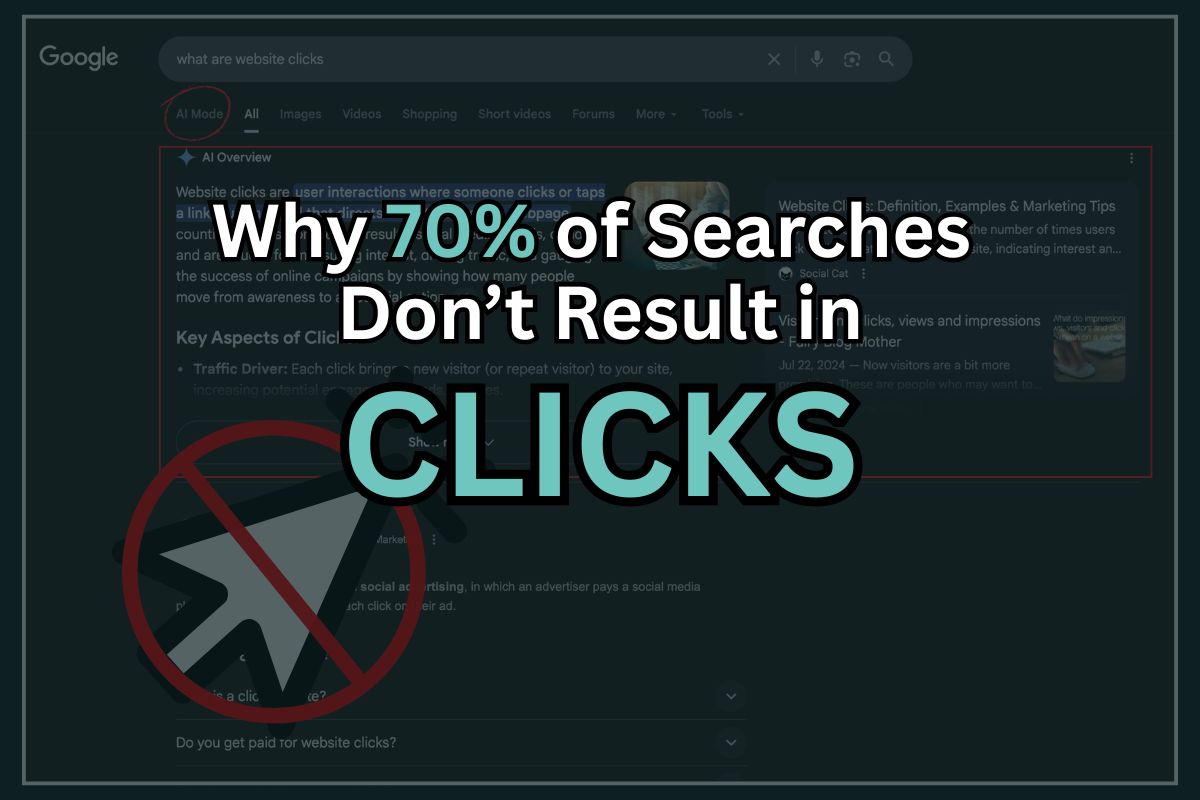
Imagine you type a question into a search engine and get the answer right there on the search page. No need to click. That’s a “zero-click search.” It means a user’s query is answered without ever visiting a website. Instead of being directed to a link, they get immediate info via a featured snippet, knowledge panel, map, AI summary, or other search-engine result page (SERP) features. For publishers and websites relying on traffic, this has become a big deal.
The Data: Yes, It’s Real And It’s Massive
The shift toward zero‑click searches isn’t hypothetical or marginal any longer. It is now the dominant pattern for many queries and the numbers are everywhere you look.
A landmark 2024 study by SparkToro and Datos (a clickstream-data provider tied to Semrush) found that 58.5% of Google searches in the United States ended without a click to an external website, while in the European Union the rate was slightly higher at 59.7%. That means that, out of every 1,000 Google searches in the U.S., only around 360 clicks actually go out to the “open web.”
That’s already a seismic shift compared to a few years ago. Earlier estimates from panels like the now‑defunct “Jumpshot” put the no‑click share at around 50% circa 2019.
Multiple recent analyses indicate that the trend continues climbing. Some industry reviews in 2025 place the global zero‑click rate in the 60–65% range, with mobile search often registering even higher — sometimes above 75% zero-clicks.
A March 2025 snapshot revealed that in the U.S., only 40.3% of searches resulted in a click to an organic (non-Google) result, down from 44.2% the previous year.
Meanwhile, many of the “clicks that still happen” go to properties owned by the search engine itself: maps, video platforms, answer boxes, or other internal services.
To put it bluntly: for a majority of searches, the open web doesn’t get the traffic. The search engine (or its AI features) keeps the user.
This isn’t a small trend. It’s a structural change in how people search. Search engines are evolving from “doorways to the web” into “self-contained answer engines.” And for publishers, content creators, and businesses, that change matters.
What’s Driving the Shift
Several major developments have contributed to this seismic change:
-
Answer boxes, Featured Snippets, Knowledge Panels, Local Packs, and Maps: For simple factual, navigational, or local queries (like opening hours, directions, definitions, weather, conversions), users often get everything they need right on the search page.
-
AI-generated summaries and “AI Overviews”: With generative AI features now embedded in search results, search engines increasingly synthesize answers from multiple sources. This means users get comprehensive responses without leaving the SERP.
-
Mobile search behavior: On mobile devices, zero-click rates tend to be even higher. Many users browsing on phones appreciate quick answers without loading another page.
-
Changing user expectation: As search engines become smarter and more helpful directly in the results, users have grown accustomed to getting their answers immediately. Why bother clicking if you already got what you need?
In short: the barrier between “search” and “answer” has collapsed.
Why Publishers Are Getting Less Traffic
For news sites, blogs, content publishers, directories, and businesses that depend on organic search traffic, this shift is brutal. Here’s why:
-
Fewer visits — even if you rank #1: Even strong search ranking no longer guarantees clicks. If a SERP provides the answer, users may never land on the page.
-
Loss of ad / affiliate revenue: With fewer pageviews, ad impressions fall, affiliate conversions drop, and the value of content for monetization shrinks.
-
Devaluation of traditional SEO — at least as it was known: Suddenly, keywords and backlinks are no longer the only game. Ranking high but not getting clicked means your investment in content and SEO yields little return.
-
Traffic volatility for informational and “how-to” content: Queries that are informational — the kind many blogs produce — are most likely to be answered directly by the search engine, bypassing publishers entirely.
One recent example: for news-related queries, the zero-click rate has reportedly climbed from around 56% in 2024 to nearly 69% by May 2025.
It’s like a joke among web-publishers: “We spent all that time writing the perfect article — and Google just owned us with a snippet.” One day you’ll think it will work… but nope: More Ads, Zero Clicks, All AI Snippets.
How Is This Changing And Where Are We Headed
The zero-click trend isn’t static. It’s evolving and likely intensifying.
-
AI-powered search features are spreading quickly. Search engines are continuously investing in generative AI, knowledge graphs, and enhanced SERP features that answer more complex queries on the spot.
-
Mobile-first search behavior continues to grow. More searches are happening on devices where zero-click features are optimized.
-
SEO strategies are shifting. Marketers are experimenting with “answer-engine optimization” (AEO) — optimizing content so it gets cited directly by AI summaries.
-
Content value matters more than ever. Pages with unique research, data, or deep analysis where things harder to compress into a snippet are more likely to earn clicks, repeat visits, or long-term engagement.
While many searches now end without a click, the shape of “winning online” is shifting. It’s no longer about chasing clicks but it’s about being useful, credible, and worthy of being cited, listed, or bookmarked.
What Should Website Owners & Publishers Do
If you run a site (like a business blog, news outlet, content hub, or directory), this shift should be a wake-up call.
- Think beyond clicks. Track brand mentions, “assisted conversions,” time on site and not just pageviews.
- Create content that’s hard to answer with a quick snippet: deep analysis, original data, case studies, interactive tools, unique perspectives.
- Use structured data (schema markup) and help search engines understand your content so it can shine if featured.
- Build your brand presence outside search like newsletters, social channels, community engagement, so you’re not solely dependent on SERP clicks.
- Embrace the new reality: aim to be cited by AI summaries, not just clicked. Think of being “owned as sources.”
The Bottom Line (And a Little Joke)
Yes, if you’ve been worrying about dropping traffic, you’re not alone. Traditional organic-click traffic is shrinking. But this doesn’t mean the internet is dead. It just means search changed.
Picture this: you publish a killer article. You check your analytics one week later… and it looks like no one came. But then you see your content footnoted inside dozens of AI summaries. That’s right — you got “owned.” One day it’ll feel like you should have gotten the clicks. Instead: More Ads, Zero Clicks, All AI Snippets.
But here’s the silver lining: this transformation levels the playing field. If you adapt with quality, authority, and strategy, you can still win. Maybe clicks won’t come. Maybe they’ll come later. Maybe they’ll come outside search. But you’ll still matter.
Credible Sources & Further Reading
-
Nearly 60% of Google searches end without a click in 2024 — Search Engine Land
-
Zero‑Click Search Research 2025: Analysis of multiple global studies — SEO Bazooka
-
Is AI Search Killing Website Traffic? — implications for publishers
-
Why zero-click & AI-driven search are changing SEO forever in 2025 — Boston Institute Of Analytics