
For many years, business owners in the skilled trades focused on building a solid company, creating jobs, and serving their local communities. Whether it was an HVAC company, plumbing contractor, electrical business, or mechanical services firm, the traditional exit strategy was usually simple: sell to a competitor, pass the business to family, or close the doors upon retirement.
Today, a new trend is changing the landscape across Canada. Private equity firms are increasingly investing in blue collar industries through what are known as private equity roll ups.
For many trades business owners, this has become a legitimate path to retirement, wealth creation, and even generational financial security.
What Is a Private Equity Roll Up?
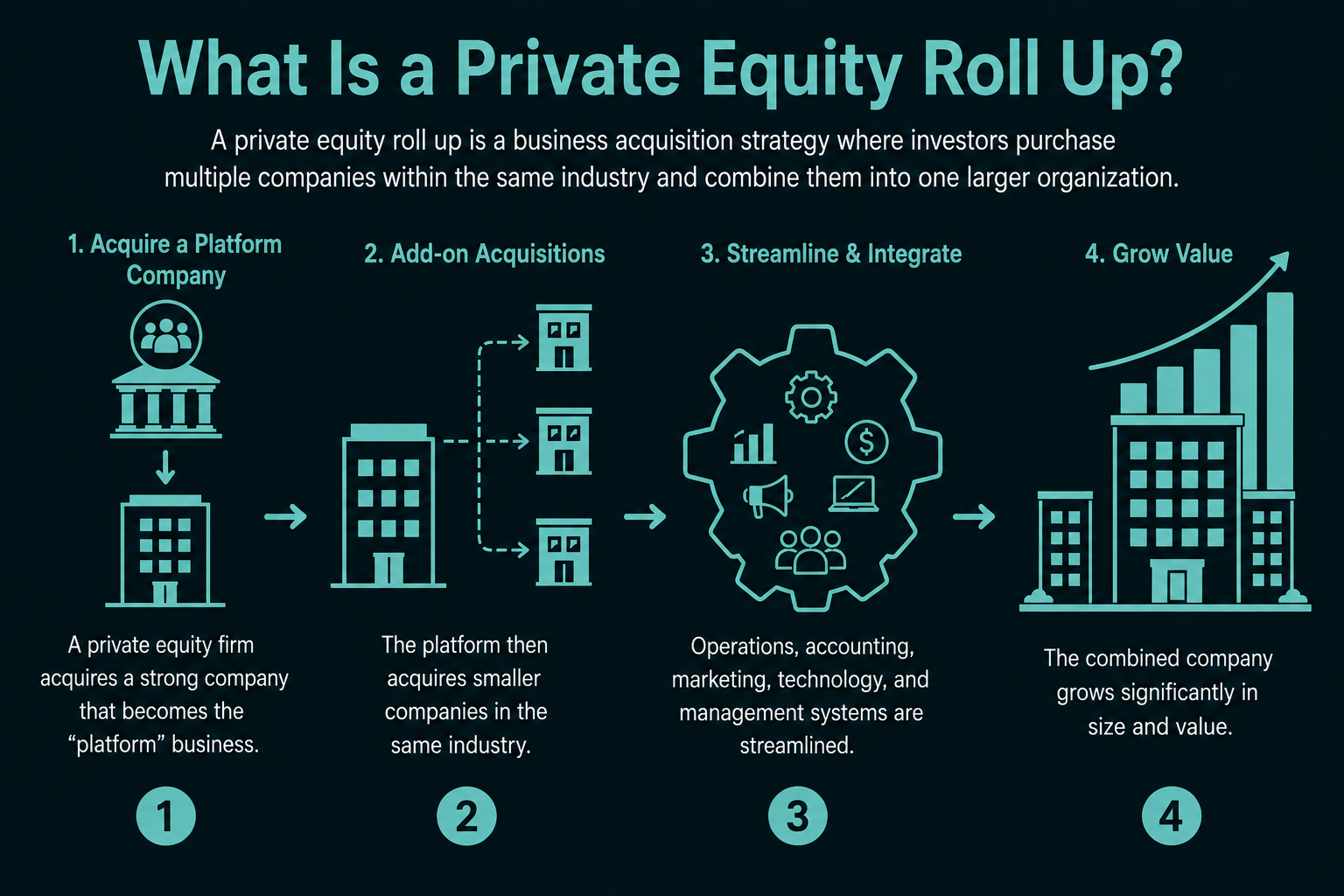
A private equity roll up is a business acquisition strategy where investors purchase multiple companies within the same industry and combine them into one larger organization.
The process usually looks like this:
- A private equity firm acquires a strong company that becomes the “platform” business.
- The platform then acquires smaller companies in the same industry.
- Operations, accounting, marketing, technology, and management systems are streamlined.
- The combined company grows significantly in size and value.
The goal is to create a larger organization that is more efficient, more profitable, and ultimately worth far more than the individual businesses on their own.
In Canada, this strategy has become particularly popular in trades industries such as:
| Industry | Typical Valuation Multiple* |
| HVAC services | 4x to 8x EBITDA (up to 10x+ for large platform companies with recurring maintenance revenue) |
| Plumbing companies | 3x to 6x EBITDA (6x to 8x for larger PE backed platform acquisitions) |
| Electrical contractors | 4x to 7x EBITDA (premium firms can exceed 8x) |
| Mechanical contracting | 4x to 7x EBITDA depending on commercial contracts and recurring service work |
| Restoration services | 4x to 8x EBITDA for established businesses with diversified insurance relationships and management teams |
| Home services platforms | 7x to 10x+ EBITDA once multiple trades are combined into a regional or national platform |
*These are broad industry ranges. Actual valuations depend on profitability, recurring revenue, management depth, geographic market, customer concentration, and deal structure.
These industries offer recurring demand and essential services that customers cannot easily postpone. A homeowner may delay renovating a kitchen, but they cannot ignore a broken furnace in January or a burst water pipe. That predictable demand is one reason private equity firms are willing to pay premium valuations for well run trades businesses.
One of the biggest drivers of higher valuations is recurring revenue. HVAC companies with maintenance agreements, plumbing businesses with service memberships, and electrical contractors with long term commercial service contracts often receive significantly higher multiples than businesses that rely solely on one off installation projects. Buyers are paying for predictable cash flow, not just today’s profits.
Why Private Equity Loves Trades Businesses
Private equity investors are attracted to industries that provide predictable revenue and strong long term demand.
Trades businesses fit that profile perfectly.
People may delay buying a new vehicle or renovating their kitchen, but they still need:
- Heat during the winter
- Air conditioning during the summer
- Working plumbing systems
- Safe electrical systems
When critical systems fail, customers need service immediately.
This creates consistent demand regardless of broader economic conditions.
According to the Mechanical Contractors Association of Canada, the mechanical contracting sector contributes more than $33 billion to Canada’s GDP and employs over 205,000 Canadians. The industry includes HVAC, plumbing, and other essential building systems that support homes, businesses, and infrastructure.
For investors, that stability is extremely attractive.
Why Many Trades Owners Are Selling
A major factor driving acquisitions in Canada is the aging business owner population. Canada is currently experiencing a massive succession event, often referred to as the $300 billion business transfer wave, as thousands of owners approach retirement and look for exit options.
For many founders in the trades, their business represents decades of hard work.
Private equity often offers something traditional buyers cannot:
- Competitive valuations
- Flexible deal structures
- Faster transactions
- Opportunities to retain ownership in a larger company
This final point is especially important.
The Power of Rolling Equity Forward
One reason private equity roll ups have become so popular is the concept of equity rollover.
Instead of selling 100% of their company, owners may sell a majority stake while keeping a minority ownership position in the larger platform.
These transactions may also include performance based payments known as earn outs, allowing sellers to receive additional compensation if the business achieves specific growth targets after closing.
This allows them to:
- Take money off the table immediately
- Reduce personal risk
- Continue participating in future growth
- Potentially receive a second payout when the larger company is sold
Many founders have watched their local company become part of a regional or national organization worth hundreds of millions or even billions of dollars.
For owners who started with a truck, some tools, and a small customer list, the financial impact can be life changing.
Why HVAC, Plumbing, and Electrical Are Leading the Trend
Not every industry attracts private equity attention.
Trades businesses have several advantages:
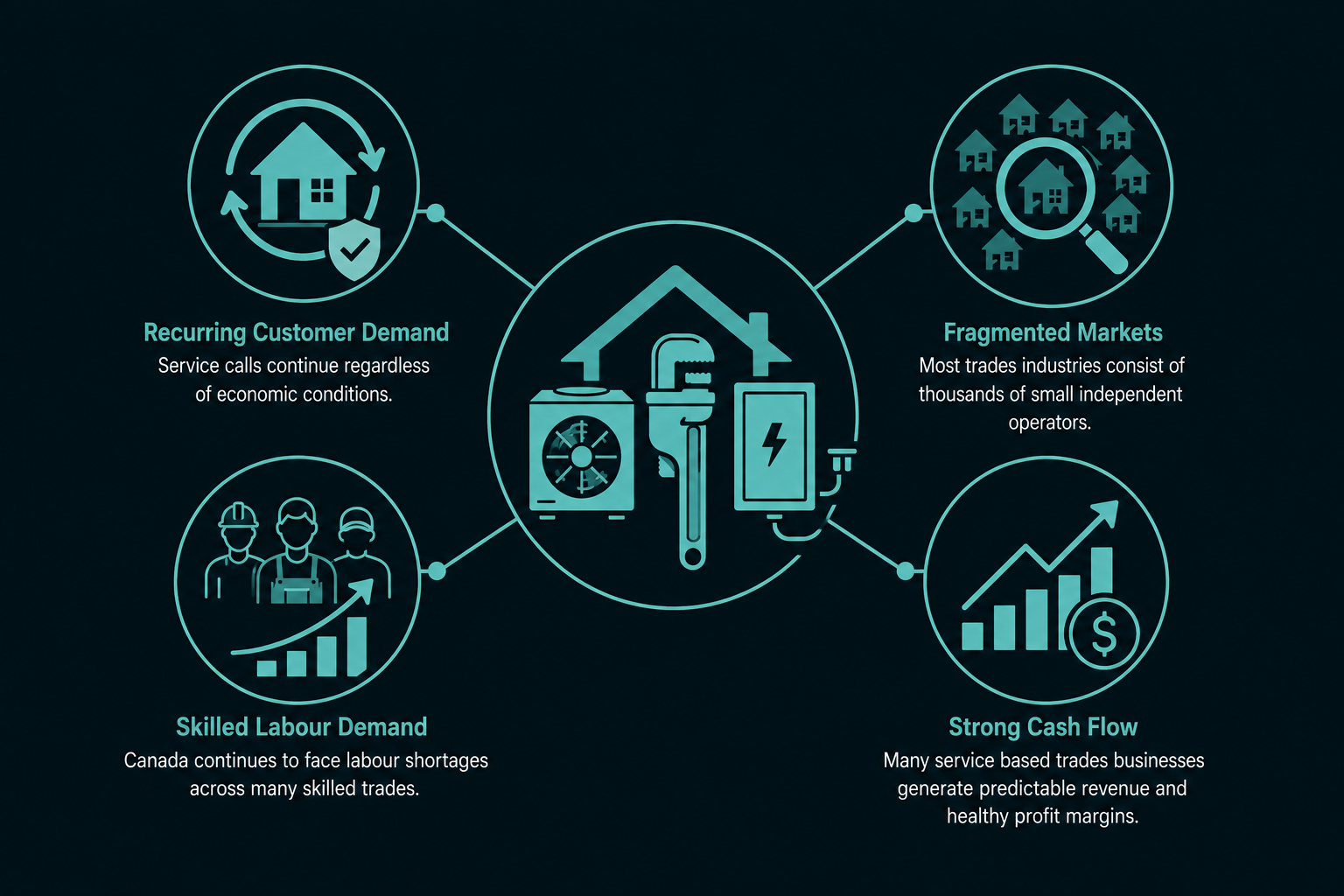
Recurring Customer Demand
Service calls continue regardless of economic conditions.
When a furnace stops working in January or an air conditioner fails during a summer heatwave, homeowners need immediate help.
Fragmented Markets
Most trades industries consist of thousands of small independent operators.
This creates opportunities for consolidation through acquisitions.
Skilled Labour Demand
Canada continues to face labour shortages across many skilled trades.
Recent apprenticeship data shows that more than 101,000 Canadians registered for apprenticeships in 2024, a record high. Despite that growth, the industry still faces significant workforce challenges as experienced tradespeople retire.
Strong Cash Flow
Many service based trades businesses generate predictable revenue and healthy profit margins, making them attractive acquisition targets.
The Benefits for Business Owners
A successful roll up can create several advantages for founders.
Financial Security
Owners can unlock the value they have built over decades. Understanding how to value a business is often the first step in determining whether a private equity acquisition or roll up opportunity makes financial sense.
Reduced Administrative Burden
Larger organizations often provide support for:
- Accounting
- Human resources
- Marketing
- Technology
- Recruiting
Growth Opportunities
Access to additional capital can accelerate expansion into new markets and services.
Succession Planning
Many owners do not have family members interested in taking over the business.
Selling into a platform can provide a smooth transition for employees and customers.
The Challenges of a Roll Up
While private equity roll ups can be highly beneficial, they are not perfect for every company.
Some challenges include:
Less Independence
Founders who are used to making every decision may need to adjust to a larger corporate structure.
Cultural Changes
Employees may experience new systems, processes, and expectations.
Integration Risks
Not every acquisition is successful.
Combining multiple businesses requires careful planning and execution.
Different Priorities
Private equity firms focus heavily on growth, profitability, and operational efficiency, which may differ from a founder’s original vision.
Business owners should carefully evaluate potential buyers and understand how their company will fit into the broader organization.
The Future of Roll Ups in Canada
The trend shows little sign of slowing down.
Private equity backed acquisitions remain highly active in the HVAC sector and related trades industries. Investors continue to seek opportunities to build larger service platforms through strategic acquisitions.
At the same time, Canada faces a significant wave of business ownership transitions as thousands of entrepreneurs approach retirement.
These two forces are creating ideal conditions for continued consolidation.
For well run trades businesses with strong management teams, recurring customers, and healthy financial performance, acquisition opportunities are likely to remain strong.
Conclusion
Private equity roll ups are no longer just a Wall Street concept. They have become a real exit strategy for many Canadian trades business owners.
When structured properly, they allow founders to monetize years of hard work while maintaining an ownership stake in a larger and potentially more valuable company.
For HVAC contractors, plumbers, electricians, and other blue collar entrepreneurs, the opportunity can be significant. A business that once served a single community may eventually become part of a regional or national platform, creating wealth that extends well beyond retirement.
Like any business decision, a roll up is not the right fit for everyone. For some owners, a traditional sale, management buyout, or broader mergers and acquisitions strategy may ultimately deliver a better outcome.