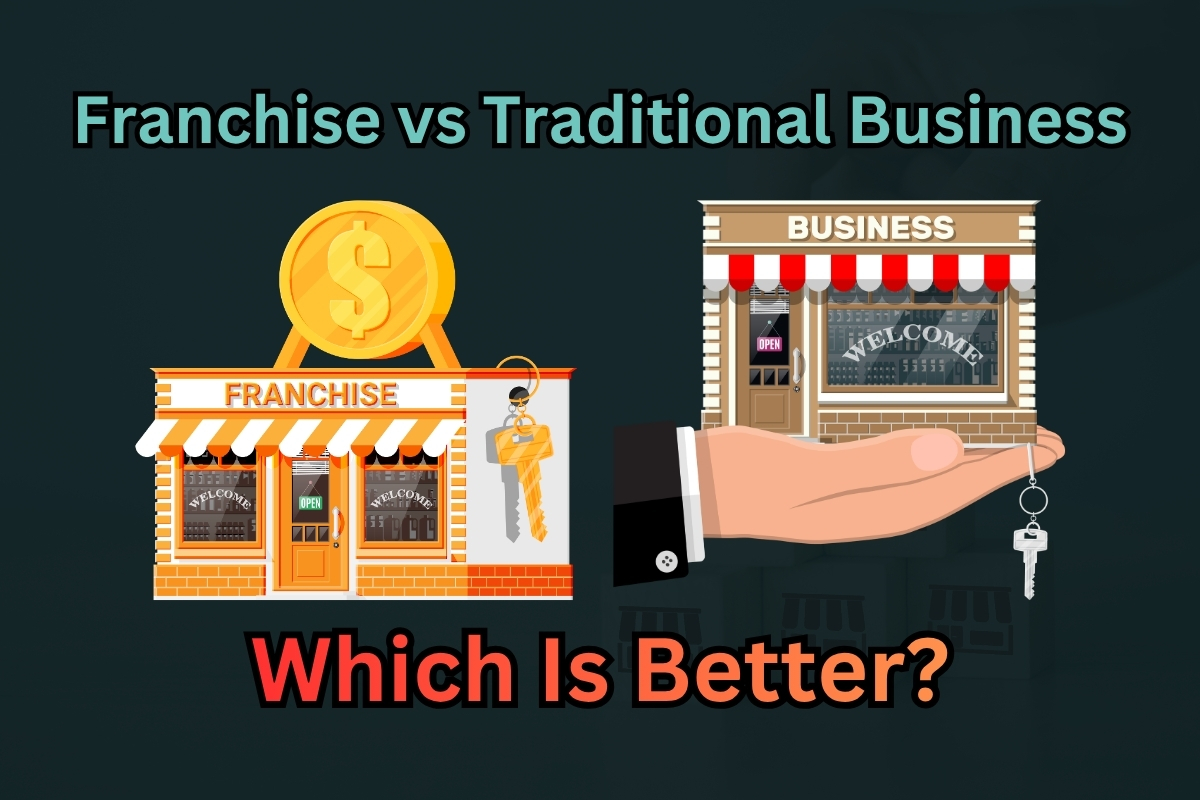
Buying a business is one of the biggest financial decisions you’ll ever make. One question many buyers ask is whether they should purchase a franchise or an independent business.
Both options can be excellent investments, but they come with different risks, costs, and opportunities. A franchise gives you an established brand and proven systems, while an independent business offers more flexibility and control.
The best choice depends on your goals, experience, budget, and personality. Let’s compare both options and look at some interesting franchise business stats in Canada.
If you’re still early in your search, our step by step guide on how to buy a business walks through the entire acquisition process from finding opportunities to closing the deal.
What Is a Franchise?
A franchise is a business that operates under an established brand. Instead of building everything from scratch, you purchase the right to use the company’s name, operating systems, marketing, and business model.
Well known examples include restaurants, fitness centres, automotive services, cleaning companies, home services, and retail stores.
As a franchise owner, you’re still running your own business. However, you’ll typically pay an initial franchise fee along with ongoing royalty and marketing fees in exchange for support and the right to use the brand.
What Is a Traditional Business?
A traditional business is independently owned. You are free to make your own decisions regarding branding, suppliers, pricing, marketing, and operations.
Many business buyers purchase existing independent businesses because they already have employees, customers, equipment, and an established reputation in the local community.
Unlike franchises, there are usually no royalty payments or corporate rules to follow.
The Canadian Franchise Industry by the Numbers
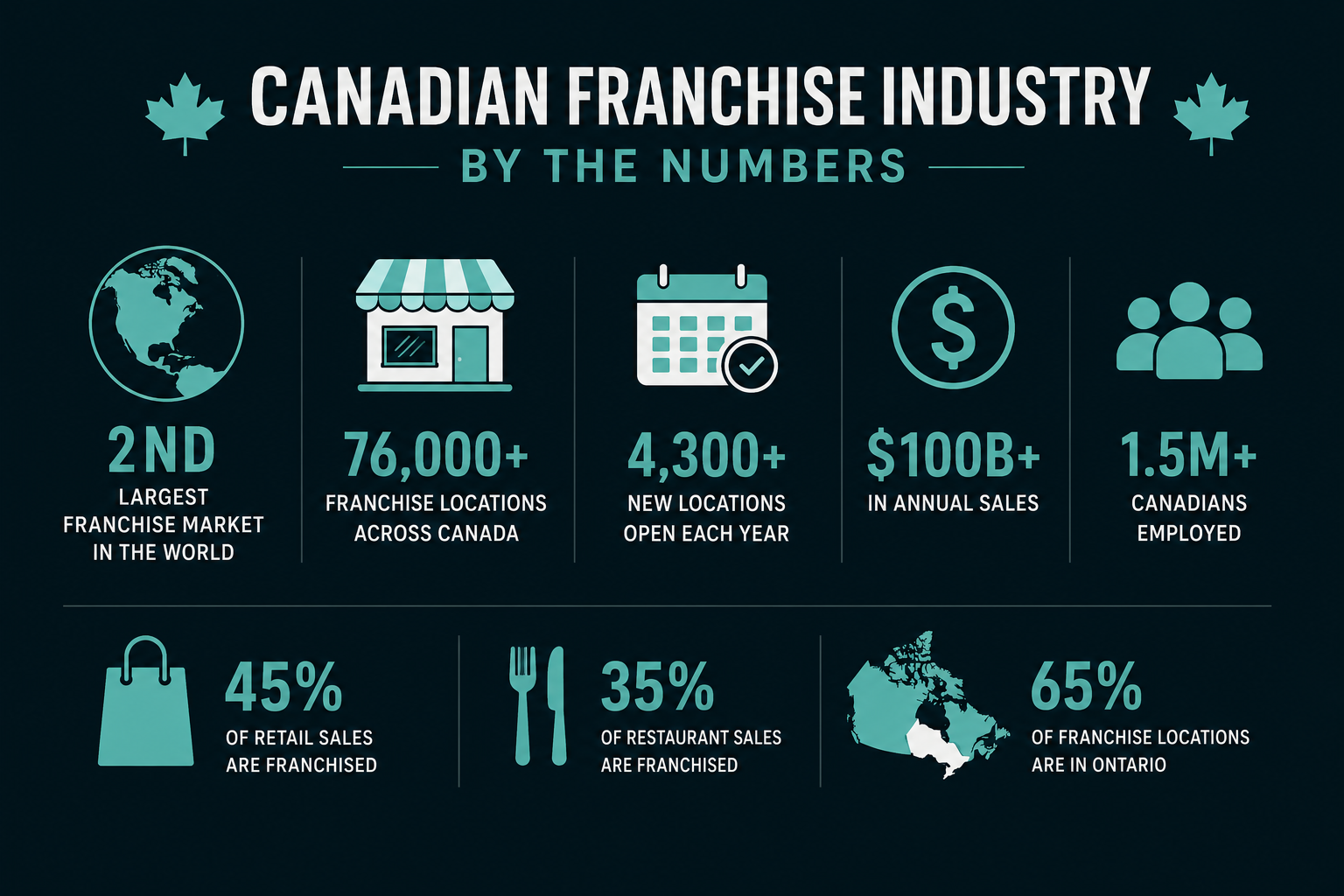
Franchising plays a massive role in the Canadian economy, shaping how consumers shop, dine, and access everyday services. According to industry data from Franchise101, Canada holds the second largest franchise market in the world, positioned right behind the United States. Between 1,200 and 1,300 franchise brands operate approximately 76,000 individual outlets nationwide. That presence translates to one franchise location for every 450 Canadians, showing just how deeply embedded these businesses are in daily life.
The growth rate of franchised outlets across the country remains remarkably steady year after year. Around 4,300 new franchise locations open annually, which means a new franchise opens its doors roughly every two hours and thirty six minutes. Furthermore, franchising represents over $100 billion in annual sales and accounts for 5 percent of Canada’s Gross Domestic Product. The sector also employs more than 1.5 million people, meaning about 1 out of every 10 working Canadians earns a living within a franchised business.
- Retail and restaurant dominance is a major driver of these numbers. Franchised operations account for 45 percent of all retail sales and 35 percent of all restaurant sales across Canada. You can learn more about industry standards through the
Canadian Franchise Association - Geographical concentration is particularly strong in certain regions. Ontario leads the nation with 56 percent of franchise headquarters and 65 percent of all locations, though Western Canada continues to experience rapid expansion.
Success Rates: Franchise System vs Independent Business
The single biggest argument in favor of buying a franchise centers on long term survival and risk reduction. Building a traditional independent business means creating every system, branding asset, supply chain, and marketing campaign completely from scratch. While independent ownership grants total creative freedom, it also leaves you vulnerable to the steep learning curve that causes many new ventures to struggle during their first few years.
Franchise systems mitigate that early vulnerability through proven operational playbooks and pre existing customer recognition. Data published by Franchise101 reveals an impressive stability rate for Canadian franchisees. Of all the new franchise locations opened in Canada over a five year period, 97 percent remained in business, and 86 percent stayed under the very same ownership.
-
Independent startups face a noticeably tougher trajectory. Data from
Statistics Canada -
Built in support networks give franchisees a distinct cushion. Having access to group purchasing power, ongoing training, and nationwide advertising allows franchise owners to focus on day to day execution rather than reinventing operational processes.
Global Economic Trends and Franchise Resilience
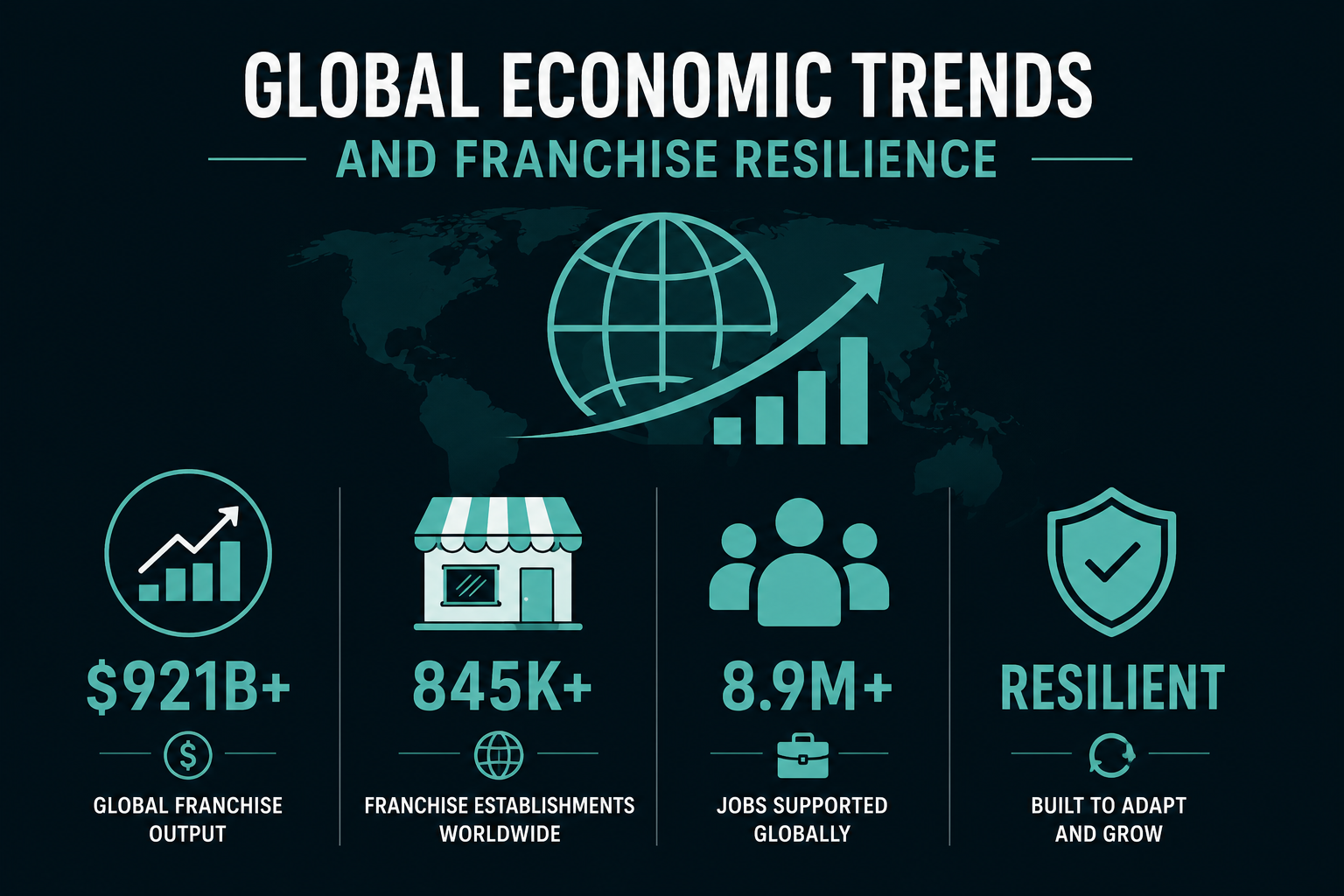
The strength of the franchise business model is not limited to Canada alone; it reflects a global trend toward structured entrepreneurship. Insights from the International Franchise Association Economic Outlook highlight how franchising continues to outperform broader economic forecasts worldwide. Global franchise output is projected to grow to over $921 billion, with total franchise establishments expanding past 845,000 units globally.
This sustained expansion is driven by strong consumer demand across diverse sectors including commercial services, residential upkeep, child care, lodging, and food service. Total franchise employment internationally is anticipated to approach 8.9 million jobs, demonstrating that franchised business models maintain remarkable resilience even during shifting economic cycles. Investors seeking stable cash flow and established market presence increasingly favor franchised systems because they offer predictable frameworks that adapt well to economic changes.
Financial Considerations and Startup Costs
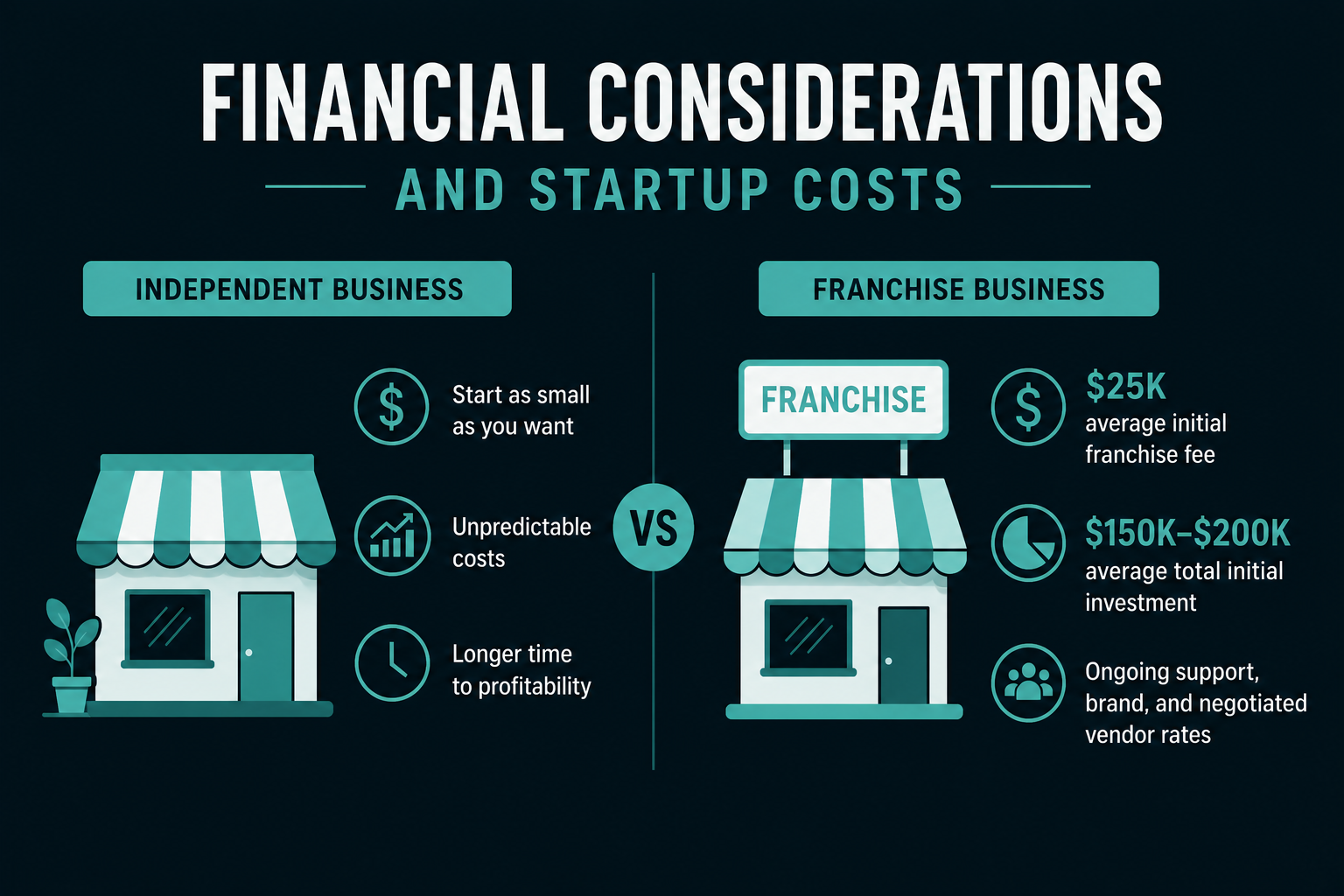
Starting or buying any business requires a clear understanding of your initial financial commitment and ongoing obligations. Traditional independent businesses offer complete flexibility over budget allocation, meaning you can start as small as you want. However, independent startups often suffer from unpredictable unexpected costs, variable supplier pricing, and longer periods before reaching profitability due to lack of initial brand recognition.
Franchises require structured upfront capital, but they provide far greater financial predictability. The average initial franchise fee in Canada sits around $25,000, while the average total initial investment required to open a franchise ranges between $150,000 and $200,000 depending on the sector. While franchisees must pay ongoing royalty and marketing fees, those costs buy continuous corporate guidance, negotiated vendor rates, and shared marketing assets that an independent business owner would have to fund entirely on their own.
-
Capital requirements vary widely depending on whether you purchase a service based home business or a physical commercial unit. Physical locations carry higher setup fees but often generate higher top line revenue.
-
Financing is frequently easier to secure for a franchise purchase. Financial institutions often view established franchise systems as lower risk investments compared to unproven independent ventures.
If you need financing, it’s also worth learning about the Canada Small Business Financing Program (CSBFP), which can help eligible buyers finance certain business purchases and assets.
Potential Cons of Owning a Franchise
While the stats for franchises look compelling, franchising is not without its pitfalls. The structure and predictability that make franchises appealing can also create significant friction for certain types of owners. Key downsides to keep in mind include:
-
Ongoing Franchise Fees & Royalties: In addition to the initial buy-in fee, franchisees must pay regular royalties—often calculated as a percentage of gross sales, not net profit. Even during a slow month, you still owe corporate their percentage.
-
Corporate Approval Requirements: Franchisors maintain strict oversight. You generally need corporate approval for major decisions, expansion plans, and especially when selling the business. If corporate doesn’t approve of your prospective buyer, the sale can fall through.
-
Lack of Creative Flexibility: You must adhere strictly to the franchisor’s operational manual. You cannot freely change pricing, alter menu items, modify services, or run unauthorized local advertising campaigns.
-
Mandatory Vendor Restrictions: Many franchisors require you to purchase inventory, supplies, and equipment exclusively through approved corporate vendors—preventing you from sourcing cheaper local options.
-
Shared Brand Risk: Your business reputation is partially outside your control. If the parent corporate office or another franchisee is involved in a public relations scandal, your local foot traffic can take a direct hit.
-
Capital Upgrades & Contract Terms: Franchise agreements are timed contracts (often 5 to 10 years). Franchisors may require expensive store remodels or technology upgrades as a condition for contract renewal, funded entirely out of your pocket.
Comparing the Core Advantages at a Glance
Choosing between these two paths ultimately comes down to your personal management style, risk tolerance, and long term financial goals.
| Feature | Traditional Independent Business | Franchise Business |
| Creative Freedom | Unlimited control over operations, product, and brand. | Restricted to franchisor’s system and guidelines. |
| Ongoing Fees | None (keep 100% of net profits). | Ongoing royalties and corporate marketing fees. |
| Brand Recognition | Built from scratch; takes time and capital. | Immediate built-in customer recognition. |
| Vendor Choice | Freedom to source suppliers and negotiate prices freely. | Must use corporate-approved vendors. |
| Exit Strategy | Full control over when and to whom you sell. | Requires corporate approval for new buyer transfer. |
| Survival Rate | Lower statistical survival over 5 years. | Higher stability rate (~97% remaining open over 5 years). |
Final Thoughts on Making Your Decision
Buying a franchise and buying a traditional business can both lead to long term success.
Franchises offer proven systems, established branding, and ongoing support, while independent businesses provide flexibility, greater operational freedom, and the opportunity to maximize profits without paying ongoing royalties.
The most important factor isn’t whether the business is franchised or independent. It’s whether the business has strong financial performance, recurring customers, reliable employees, and realistic opportunities for future growth.
Take your time, perform thorough due diligence, ask the right questions before buying a business, and choose the opportunity that best matches your financial goals, experience, and management style.