Food delivery apps changed the restaurant industry almost overnight. Suddenly, a small neighbourhood restaurant could appear beside national chains on a customer’s phone with no extra storefront, no delivery fleet, and very little setup.
At first, it sounded like an easy trade. The platform would bring customers, and the restaurant would pay a commission.
The problem is that many owners never stop to calculate what that commission is actually costing them.
We talk to restaurant owners across Vancouver Island all the time, and the same comment keeps coming up: “The orders keep coming, but the profit doesn’t.”
This article is not an anti delivery app rant. Apps absolutely have value. They are excellent at helping new customers discover your business. The goal is simply to look at the numbers the way a business buyer, banker, or broker would.
Delivery is now a major part of the Canadian restaurant industry
Online ordering is no longer a niche category. According to a report, off premises dining, including delivery and takeout, has become one of the fastest growing parts of the industry. Consumers increasingly expect the option to order from their phones, especially in urban and suburban markets.
That expectation means most restaurants cannot simply ignore delivery platforms. Customers are already there.
The question is not whether to be on delivery apps.
The question is how dependent you should be on them.
The math most owners never do
Let’s use a realistic example.
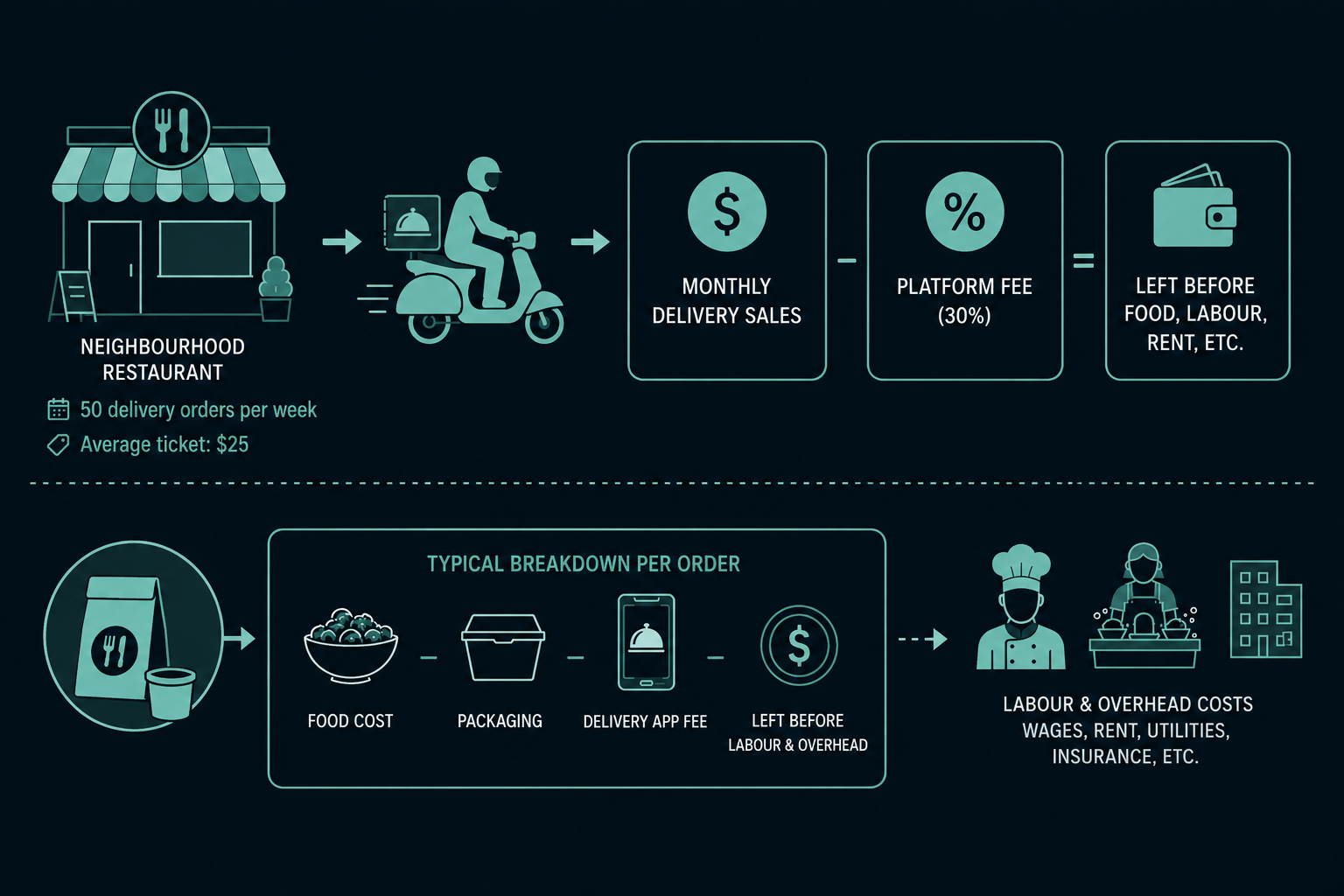
Imagine a neighbourhood restaurant doing 50 delivery orders per week with an average ticket of $25.
| Monthly delivery revenue | $5,000 |
| Platform commission (30%) | −$1,500 |
|
Remaining before food, labour, rent |
$3,500 |
At first glance, $3,500 sounds fine.
But that is not profit.
Restaurant food costs in Canada commonly run 28% to 35% of sales, depending on the concept. Add packaging, kitchen labour, utilities, and rent, and the margin shrinks quickly.
On a $25 order, a typical breakdown might look like this:
- Food cost: $8.00
- Packaging: $1.00
- Delivery app commission: $7.50
- Remaining before labour and overhead: $8.50
Now subtract the wages of the cook who made the order, the dishwasher who cleaned the equipment, and your share of rent, insurance, and utilities.
That “profitable” delivery order suddenly looks a lot less impressive.
Many owners are shocked when they realize they are doing a large volume of delivery sales while earning very little from each transaction.
The annual number is the one that hurts
Monthly fees are easy to ignore.
Annual fees are not.
Using the same example:
- $1,500 per month in commissions
- × 12 months
- = $18,000 per year
That is $18,000 leaving the business every year before you have paid yourself a dollar.
Put another way, that is:
- Several months of rent for many small restaurants
- A significant equipment upgrade
- A part time employee
- Or additional cash flow that could increase the value of the business when it is sold
This is exactly the kind of expense buyers look at during due diligence.
“But the apps bring me customers”
They do, and that is genuinely valuable.
Discovery is the strongest argument for using delivery platforms. A customer who has never heard of your restaurant can find you while browsing nearby options.
Paying for a first time customer makes sense. After all, every business has a cost of acquiring a new customer, and delivery platforms can be viewed as another marketing channel for customer acquisition.
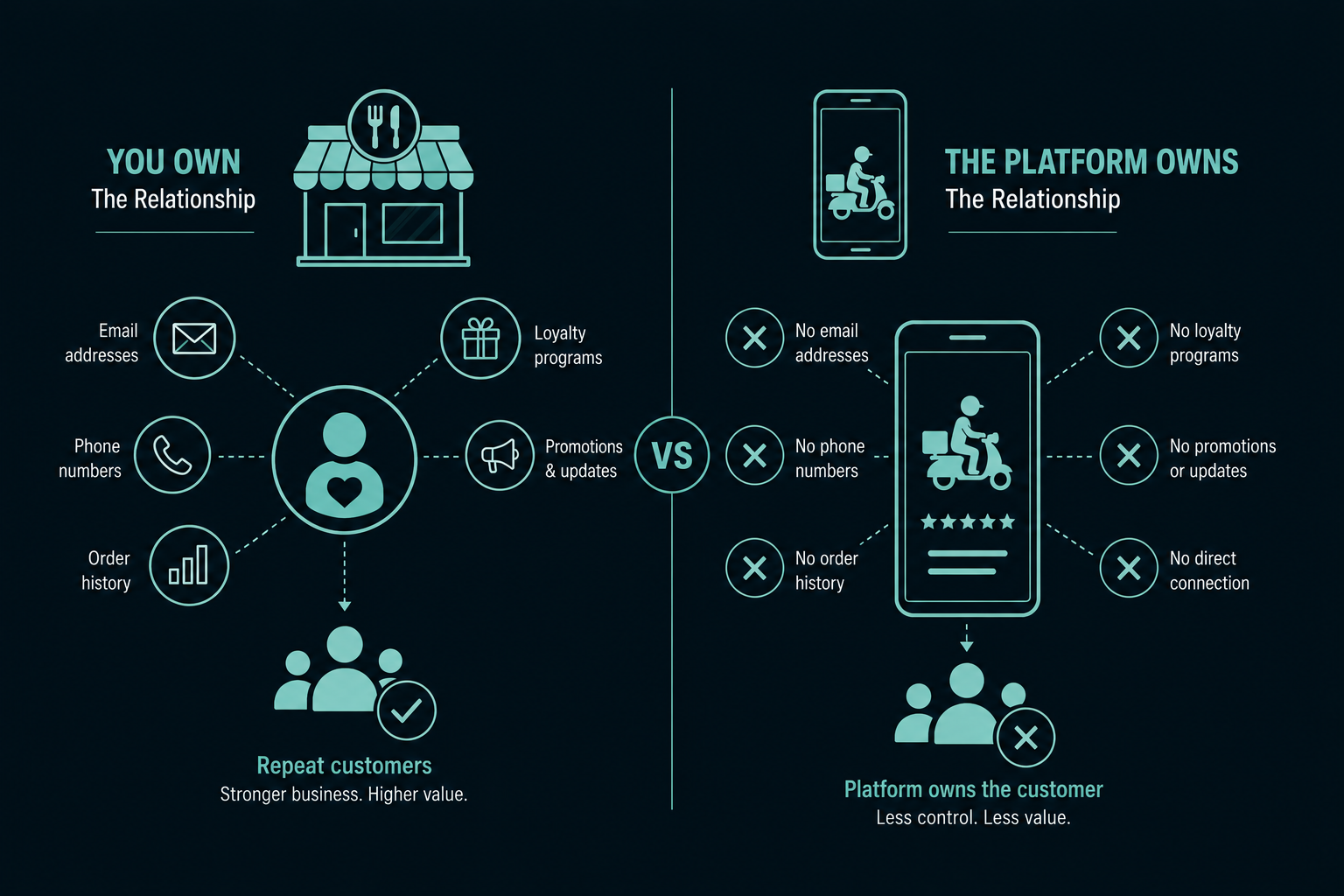
The issue is that the platform usually charges the same commission on the 500th order from a loyal regular as it does on the very first order.
That means you may be paying a permanent finder’s fee for customers who already know your food, your brand, and your location.
Ask yourself a simple question:
How many of your delivery orders come from repeat customers?
For most established restaurants, the answer is “the majority.”
That is the point where the commission starts behaving less like marketing and more like a recurring tax on existing customers.
The hidden cost of delivery apps
What “owning your delivery channel” actually means
A lot of owners hear “direct ordering” and imagine building a custom app.
That is not necessary.
Today, a direct ordering channel can be surprisingly simple.
You can start with:
- A digital menu with online ordering
- A link in your Instagram bio
- A Google Business Profile order link
- A WhatsApp or text ordering option
- A QR code on tables and takeout packaging
- A small incentive for ordering direct
The goal is not to eliminate the apps.
The goal is to give repeat customers an easy alternative.
The economics change dramatically
Let’s go back to our $25 order.
If that order comes through your own channel instead of a platform, the $7.50 commission disappears.
That does not mean delivery becomes free, but it does mean you keep the margin that was previously leaving the business.
Assume only half of your repeat customers move to direct ordering.
For our example restaurant:
- 50 delivery orders per week
- 25 migrate to direct ordering
- Commission saved: $750 per month
- Annual savings: $9,000
Nine thousand dollars a year is not a rounding error.
It is meaningful cash flow.
A smarter strategy: acquisition vs. retention
The best operators are not treating this as a crusade against delivery apps.
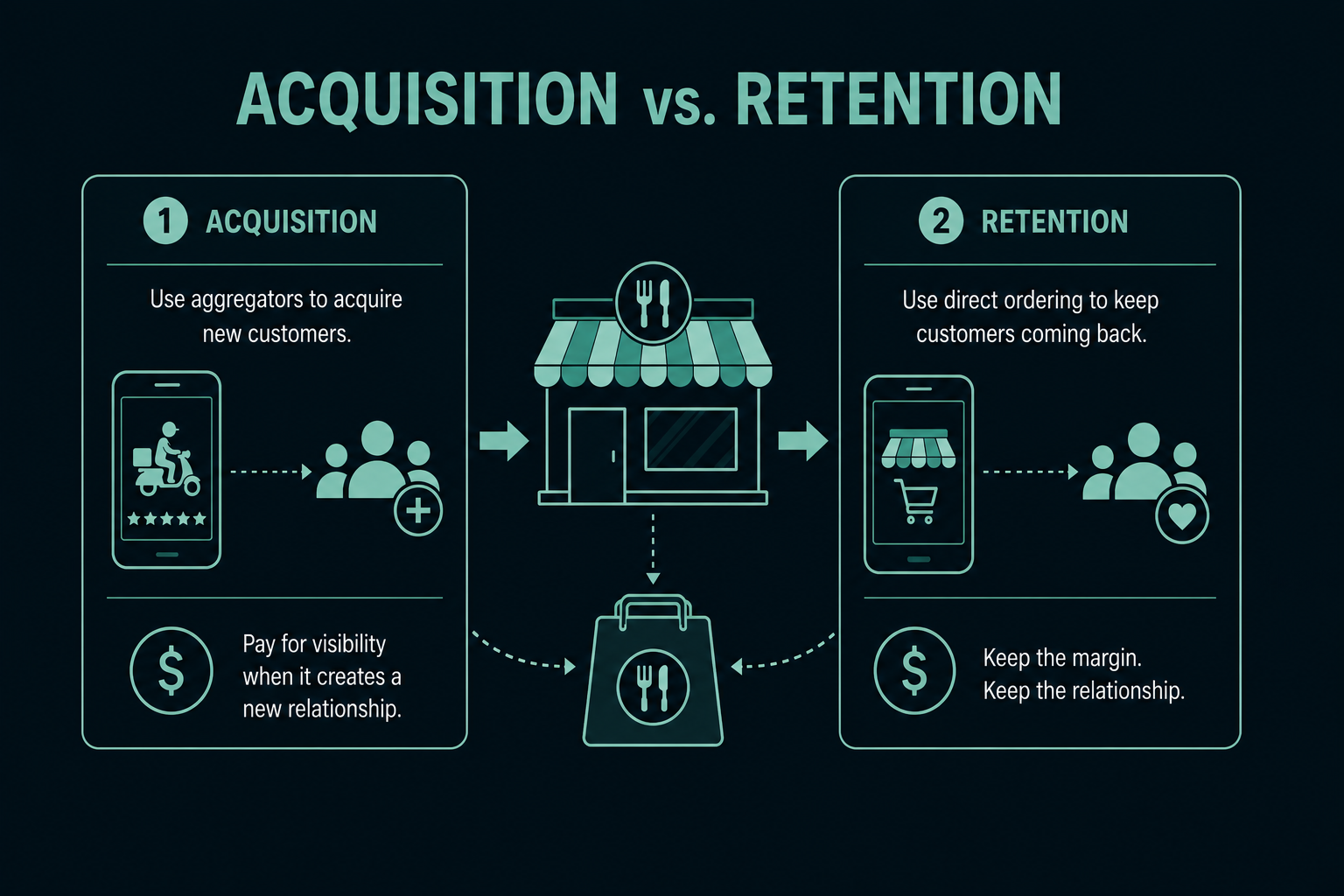
They are treating it as a two channel strategy.
Use aggregators for acquisition
Let new customers discover you there.
Pay for visibility when it is creating a relationship that did not previously exist.
Use direct ordering for retention
Encourage regulars to order directly the next time.
Keep the margin and keep the customer relationship.
Every delivery bag that leaves your kitchen is an opportunity.
Include a QR code, a loyalty offer, or a simple message such as:
“Next time, order direct and save 10%.”
That small insert can be worth thousands of dollars over the course of a year.
Why this matters when selling a restaurant
As business brokers, this is where our perspective becomes different from a typical restaurant consultant.
Buyers care about sustainable cash flow because it plays a significant role in how a business is valued. The higher the sustainable profit, the more attractive the restaurant becomes to potential buyers.
A restaurant doing $1 million in sales is not automatically valuable if a large portion of those sales is being heavily taxed by third party commissions.
A buyer will look at:
- Delivery sales as a percentage of revenue
- Average commission rates
- Direct ordering penetration
- Customer retention
- And whether the business owns any customer database
A restaurant with strong direct ordering and repeat customer relationships is often viewed as a more defensible business than one that relies entirely on third party platforms.
The bottom line
Food delivery apps are not the enemy.
They solve a real problem for consumers, and they can be an excellent customer acquisition tool for restaurants.
The mistake is assuming that high delivery sales automatically mean high profitability.
Take five minutes and calculate your own number:
Monthly delivery revenue × Average commission rate × 12
That is what delivery platform dependence is costing your business each year.
Then ask one more question:
What percentage of those orders came from people who already love your food?
The gap between those two numbers is where the opportunity lives.
For many Canadian restaurants, especially established neighbourhood operators, the biggest profit improvement available is not necessarily selling more food. It is keeping more of the revenue from the food they are already selling.