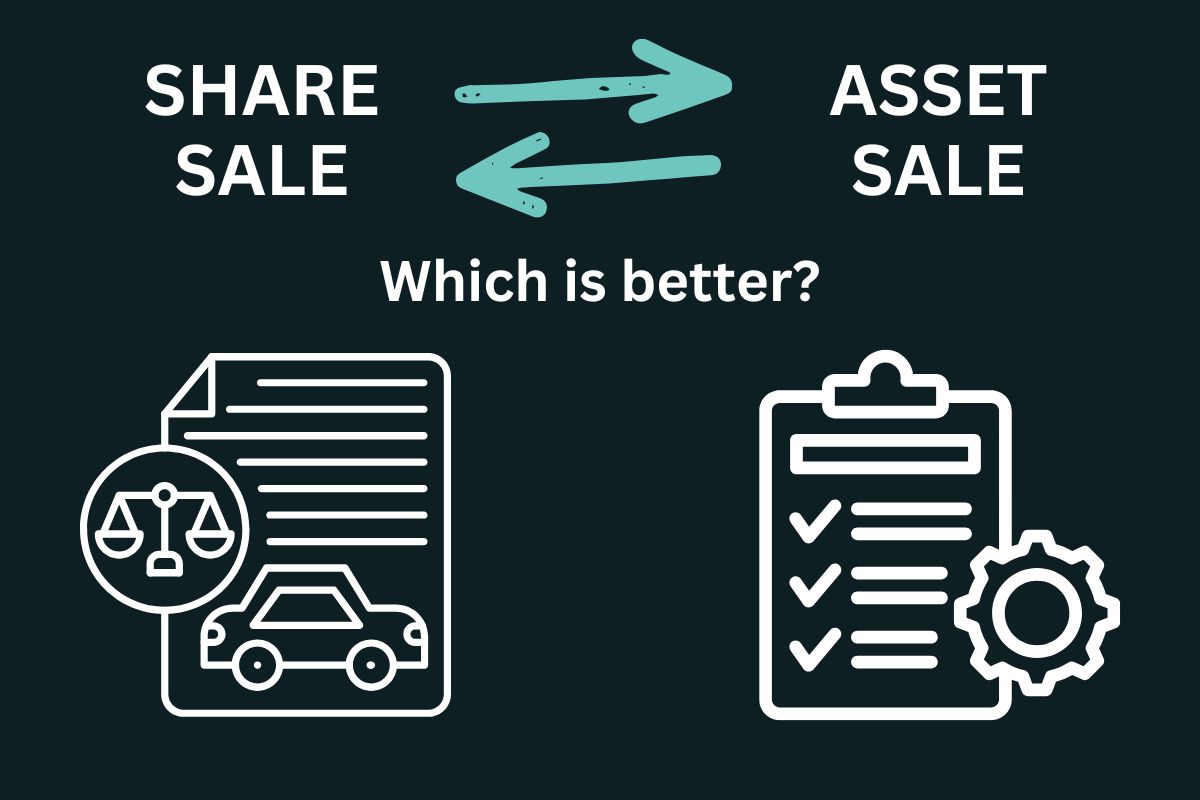
Selling a business in Canada is one of the most important financial events an owner will ever undertake. Two common structures are a share sale (buyer purchases the company’s shares) and an asset sale (buyer picks specific assets and leaves liabilities behind). Which is preferable depends on tax, liability, buyer expectations, and whether the seller can access the
What’s the difference (in plain language)
Share sale
-
Buyer acquires the legal owner of the business that is typically the corporation’s shares.
-
Buyer generally takes on the company’s contracts, employees, licences and historic liabilities (unless otherwise agreed).
-
Seller usually treats proceeds as a capital gain, which can access preferential tax treatment and, if eligible, the LCGE.
Asset sale
-
Buyer selectively purchases assets (equipment, goodwill, inventory, client lists, etc.) and often leaves liabilities with the company.
-
Buyers usually prefer asset sales because they can “step up” the tax cost (capital cost) of acquired assets for depreciation/tax purposes.
-
Sellers may face double taxation if the corporation must sell assets at the corporate level and then distribute proceeds to shareholders.
Tax implications (the headline points)
-
Sellers in a share sale: Proceeds are normally taxed as capital gains. Capital gains have a preferential inclusion rate vs normal income, and the seller may qualify for the LCGE on qualified small business corporation shares, which can dramatically reduce or eliminate tax on the gain.
-
Sellers in an asset sale: The corporation sells assets and pays tax on gains at the corporate level. If shareholders then receive liquidating distributions, those can be taxed again when paid out and potentially resulting in a higher overall tax burden. Buyers typically pay less for shares because they are taking on liabilities; conversely buyers may pay more for assets that offer tax deductions.
Other important differences (risk, complexity, price)
-
Liability transfer: Share sale = buyer inherits historical liabilities (lawsuits, tax exposures). Asset sale = buyer can avoid many legacy liabilities. This often makes asset sales more attractive to buyers and share sales more attractive to sellers.
-
Purchase price allocation: In an asset sale buyers allocate price to particular asset classes (goodwill, equipment, inventory), which affects future tax deductions. In a share sale, the buyer usually inherits historical tax bases and may negotiate a lower price to reflect unknown liabilities or tax exposures.
-
Complexity & closing: Share sales can be cleaner for sellers (one contract, one closing) but require careful due diligence and often more buyer warranties. Asset sales may need multiple assignments and consents (leases, supplier contracts), adding execution complexity.
Why the $1.25M Lifetime Capital Gains Exemption matters
Historically, older business planning materials often referenced an exemption threshold of $750,000.
The key takeaway isn’t just the higher figure, but what the LCGE does: it allows eligible sellers to shelter up to $1,250,000 in capital gains from income tax when selling qualified shares.
Basic eligibility for the LCGE (very briefly)
To claim the $1.25M LCGE on shares, the business must meet strict Canadian Revenue Agency (CRA) criteria:
- Qualified Small Business Corporation (QSBC) Status: The shares must be in a Canadian-Controlled Private Corporation (CCPC).
- Active Asset Tests: At least 50% of the corporation’s assets must be used in active business in Canada for the 24 months preceding the sale, and at least 90% at the exact time of the sale.
- Holding Period: You must have owned the shares for a minimum of 24 consecutive months prior to selling.
These rules are technical, and mistakes can disqualify a claim. In some cases, owners perform asset purification ahead of time to ensure they qualify before going to market.
Practical tips for sellers (next steps)
- Get tax and legal advice early: Structure affects taxes, purchase price, and liability.
A professional can run scenario modeling for both options before you sign an LOI (Letter of Intent). - Run an LCGE eligibility check today: If you are planning a sale, confirm your shares meet QSBC conditions — otherwise a share sale will not yield the intended $1.25M tax break.
- Negotiate price allocation: Buyers and sellers should negotiate purchase price allocations (in asset sales) or discounts (in share sales) to reflect tax outcomes and inherited risks.
- Consider indemnities & escrow: Share sales often require purchase price holdbacks or indemnities to cover undisclosed legacy liabilities. Asset sales require careful assignment of contracts and licenses.
Bottom line
- For sellers who qualify, a share sale is usually far more tax-efficient because proceeds are treated as capital gains and can be sheltered up to $1,250,000 using the
Lifetime Capital Gains Exemption However, share sales require transferring legacy risks, which may prompt buyers to negotiate indemnities or price adjustments. - For buyers, an asset sale is often preferable due to the tax step-up on depreciable assets and the ability to exclude historical liabilities, but it can involve more administrative overhead to assign contracts and licenses.