
Thinking about buying a business outside your expertise? Learn the risks, what to watch for, and when it actually makes sense.
This is one of those questions I get asked all the time, and it usually comes up when someone has found what looks like a really solid opportunity. The numbers may look good, revenue may seem strong, and the customer base may appear loyal, but then the buyer starts wondering whether they can actually step into the business if they do not know how to do the work themselves. That question comes up a lot in trades businesses, technical services, manufacturing companies, repair shops, specialty contractors, and even some retail operations where the owner still needs to understand the day to day work in order to keep things running smoothly.
My answer is usually pretty simple. For most small businesses, probably not. That does not mean it can never work, but it does mean you need to be very careful before moving forward. A lot of buyers focus on the financial side of the deal and assume that if the numbers look good, the business must be a good fit. The problem is that a business is not just a set of numbers on a spreadsheet. It is people, systems, customer expectations, operations, pricing decisions, hiring, quality control, and problem solving.
If you do not understand what is happening inside the business, then managing it becomes much harder than most buyers realize, and that can turn a promising purchase into a stressful and expensive mistake.
Why This Question Matters More Than You Think
When people buy businesses, they often focus heavily on the financial statements because that is the easiest place to start. Revenue, profit, growth, and cash flow all matter, and they absolutely should be reviewed carefully. Those numbers tell you whether the business has been performing well on paper and whether it may be worth further investigation. But the financials only tell part of the story. Operational knowledge matters just as much, and in many cases it matters even more. A business can look strong financially while still being fragile behind the scenes if the owner is the one holding everything together.
According to Innovation, Science and Economic Development Canada, small businesses make up the vast majority of Canadian businesses and employ millions of Canadians. That is a big part of why this issue matters so much. Many small businesses are still heavily dependent on the owner for day to day decisions, customer relationships, staff management, and problem solving rather than being supported by a fully independent management team.
That means when you buy a small business, you are often buying much more than a stream of income.
Before moving forward, it is also worth understanding the complete process of evaluating and acquiring a business so you know what responsibilities actually come with ownership. Read our guide on How to Buy a Business Step by Step.
You are also buying responsibility, leadership demands, and the need to understand how the business actually works. In many cases, you are not buying passive income at all. You are buying a role that requires you to manage people, make decisions, solve problems, and keep the business moving forward. If you do not understand the operations well enough to lead them, the business can become far more difficult to run than the numbers on the listing suggested.
The Small Business Trap
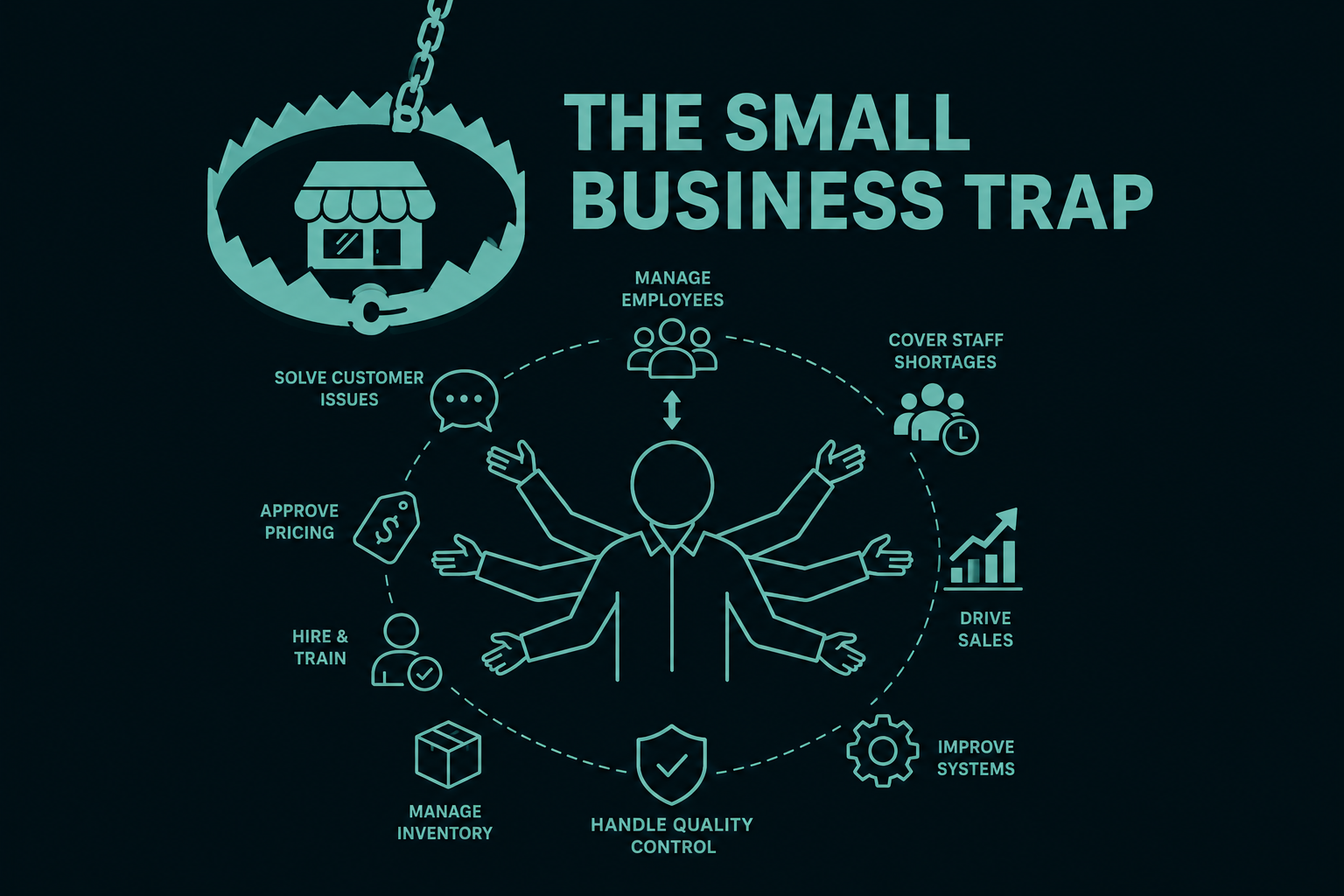
This is where people get caught.
They assume they can hire staff and step back, but in smaller businesses that rarely happens as smoothly as people hope. Even if you bring in good employees, someone still has to train them, supervise them, answer questions, check the quality of the work, and make sure the business is running the way it should. If you do not understand the work yourself, it becomes much harder to tell whether the team is performing well or whether problems are starting to build behind the scenes.
But in smaller businesses, the owner often wears multiple hats:
- Managing employees
- Solving customer issues
- Approving pricing
- Hiring and training
- Managing inventory
- Handling quality control
- Improving systems
- Driving sales
- Covering staff shortages
If you cannot step into those roles when needed, things can become difficult very quickly. A business may look stable on the surface, but if you do not understand the day to day work, you may not realize how much depends on a few key people until there is a problem. For example, buying an HVAC company without understanding service calls can make it hard to judge whether jobs are being handled properly, whether customers are being quoted fairly, or whether technicians are using time efficiently.
The same goes for purchasing a machine shop without understanding production timelines, because delays, bottlenecks, and missed deadlines can quickly affect customer satisfaction and profitability. Even acquiring a specialty retail business can be risky if you do not understand the products, because inventory decisions, supplier relationships, and customer questions all depend on knowing what is being sold and why it matters.
You may have employees who know what they are doing today, but businesses change fast. Someone gets sick, someone quits, a customer needs an answer, or a manager makes a mistake, and suddenly the owner has to step in. If you are not able to understand the work well enough to lead through those moments, the business can become much harder to manage than it first appeared.
The Questions You Need to Ask Yourself
Before buying a business you cannot operate, ask yourself some hard questions.
How Will You Manage People If You Do Not Understand Their Work?
Employees naturally look to ownership for direction, especially when something goes wrong or when they need clarity on priorities. You do not need to be the best technician in the company, and in many cases that is not even realistic. But you should understand the work well enough to evaluate performance, identify issues, ask the right questions, and make informed decisions. If you do not have that basic understanding, it becomes very easy to rely completely on other people for answers, and that can put you in a weak position as an owner.
How Will You Know If Pricing Is Correct?
Pricing mistakes can destroy margins very quickly, especially in businesses where labour, materials, and overhead costs change often.
This is also why understanding valuation matters. A business can look attractive financially while still carrying operational risks that are not obvious at first glance. Learn more in How to Value a Business.
If you do not understand labour requirements, production costs, customer expectations, or market realities, it becomes difficult to know whether pricing decisions make sense.
How Will You Know If Inventory Is Being Managed Properly?
Inventory mistakes quietly drain cash, and they are often harder to spot than other problems because they build up slowly over time. Over ordering ties up money in products you do not need yet, while stock shortages can lead to missed sales, unhappy customers, and rushed last minute purchases.
Waste, spoilage, shrinkage, and poor purchasing decisions can all create major issues that eat into profit without always being obvious right away. If you do not understand what should be ordered, when it should be ordered, and why, you lose visibility into one of the most important parts of the business. That makes it much harder to control costs, keep operations running smoothly, and make smart decisions about what the business actually needs.
What Happens If Key Employees Leave?
This might be the biggest risk of all, especially in smaller businesses where the entire operation can depend heavily on just one or two people. Sometimes that person is the owner, and sometimes it is a long term employee who knows the customers, the systems, the suppliers, and the day to day work better than anyone else. If that person leaves shortly after the acquisition, the business can change very quickly and may perform very differently than what the buyer expected. In some cases, sales drop, service quality slips, customers get frustrated, and the new owner suddenly realizes how much of the business was tied to one key person all along.
When Buying Outside Your Expertise Can Actually Work
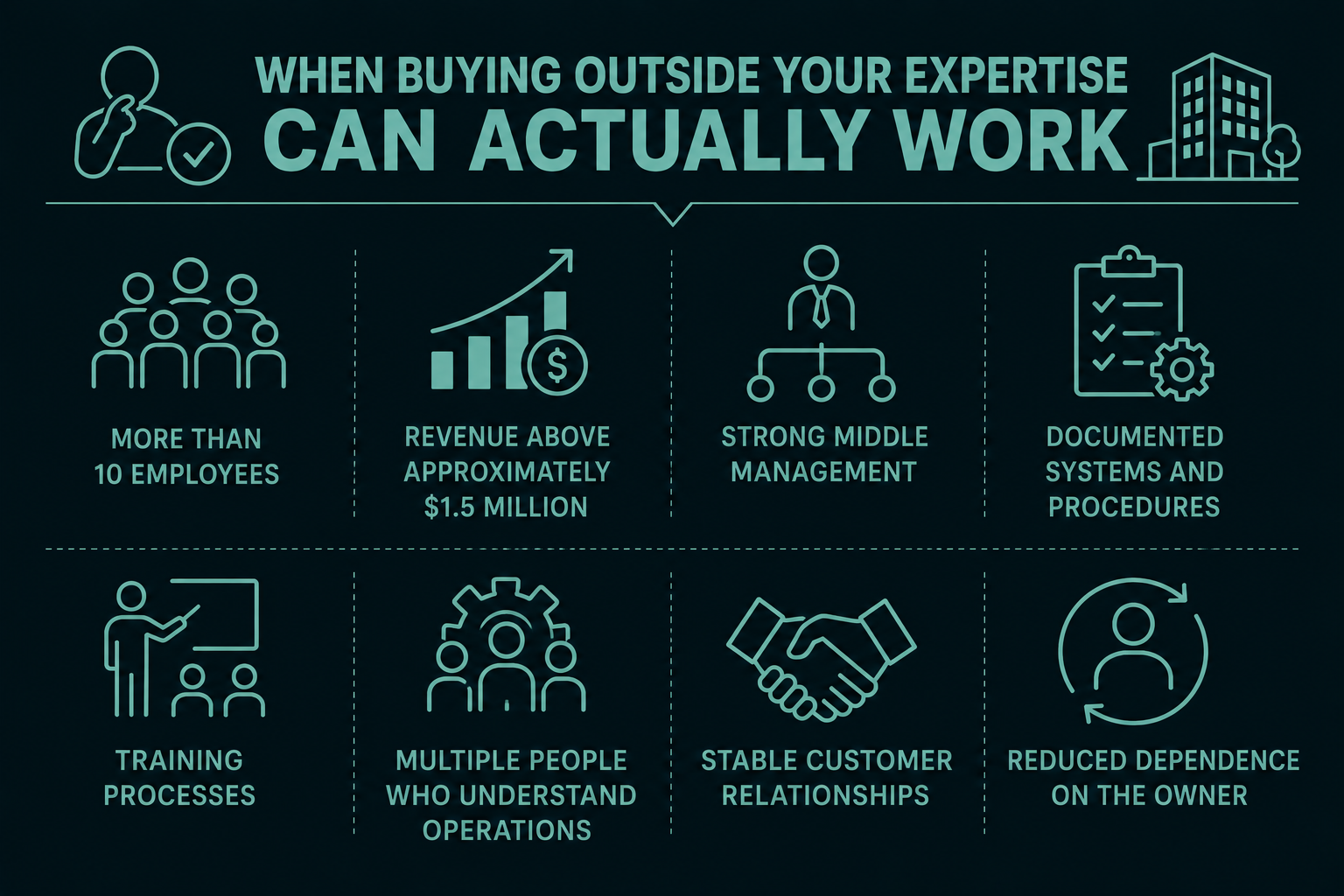
There are situations where buying a business you cannot personally operate makes sense.
Usually, I become much more comfortable when I see:
- More than 10 employees
- Revenue above approximately $1.5 million
- Strong middle management
- Documented systems and procedures
- Training processes
- Multiple people who understand operations
- Stable customer relationships
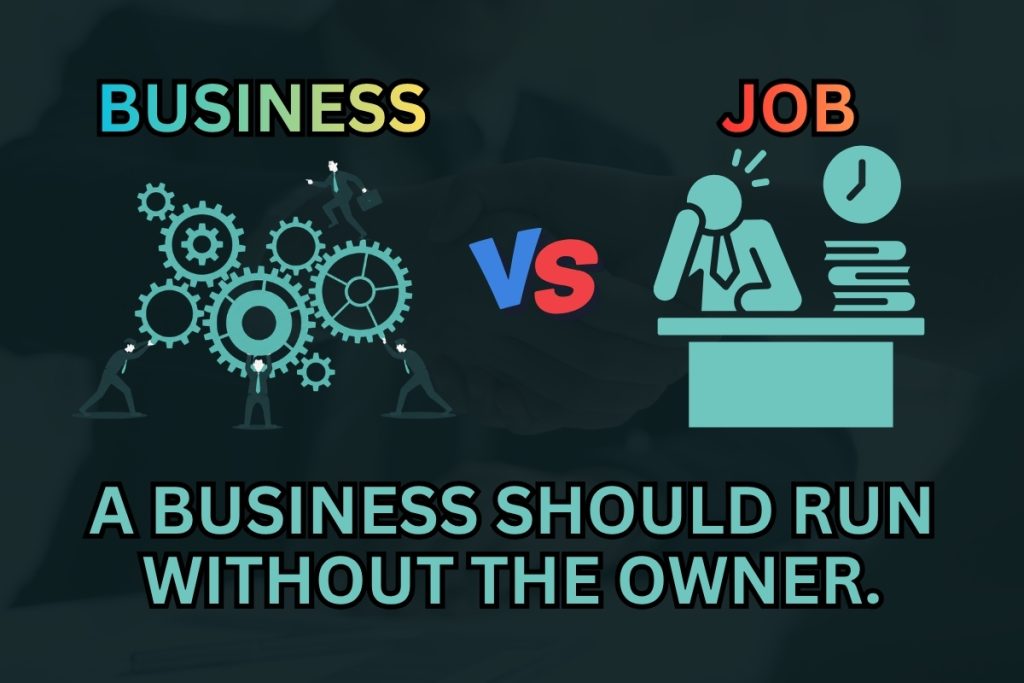
- Reduced dependence on the owner
At that point, the business often starts to feel more like a real organization than an owner operated job. There is usually enough structure in place that leadership matters more than hands on technical expertise, and the owner can focus more on guiding the business than doing every task themselves.
Instead of being involved in every detail, you are managing systems, supporting managers, and making higher level decisions that keep the business moving in the right direction. That is a completely different situation, and it is usually the point where buying a business outside your own technical skill set becomes much more realistic.
You Do Not Need To Be The Expert But You Need To Become Competent
There is an important distinction here. You do not necessarily need to perform every technical task yourself, and in many cases that is not even realistic. You do not need to be the person welding, repairing engines, installing electrical systems, or writing code every day. What matters more is that you understand how the business works well enough to make smart decisions, ask the right questions, and lead the team with confidence.
At the very least, you should be able to understand the core operations, recognize when something is off, and know what good performance looks like. If you cannot do that, then you will likely struggle to manage staff, evaluate problems, or make informed choices about pricing, quality, and growth. You do not have to be the expert technician, but you do need to understand the business deeply enough to lead it properly.
That means:
- Learning the customer journey
- Understanding pricing models
- Knowing operational bottlenecks
- Understanding employee roles
- Learning industry language
- Knowing what good performance looks like
At minimum, be ready to become an expert quickly.
Because once the deal closes, there is no pause button. You cannot wait six months to figure things out while the business keeps moving. Customers still need service, employees still need direction, and problems still need answers. If you are stepping into a business you do not fully understand, you need to be prepared to learn fast, ask the right questions, and build enough knowledge to lead with confidence.
Buying Cash Flow Means Buying Responsibility
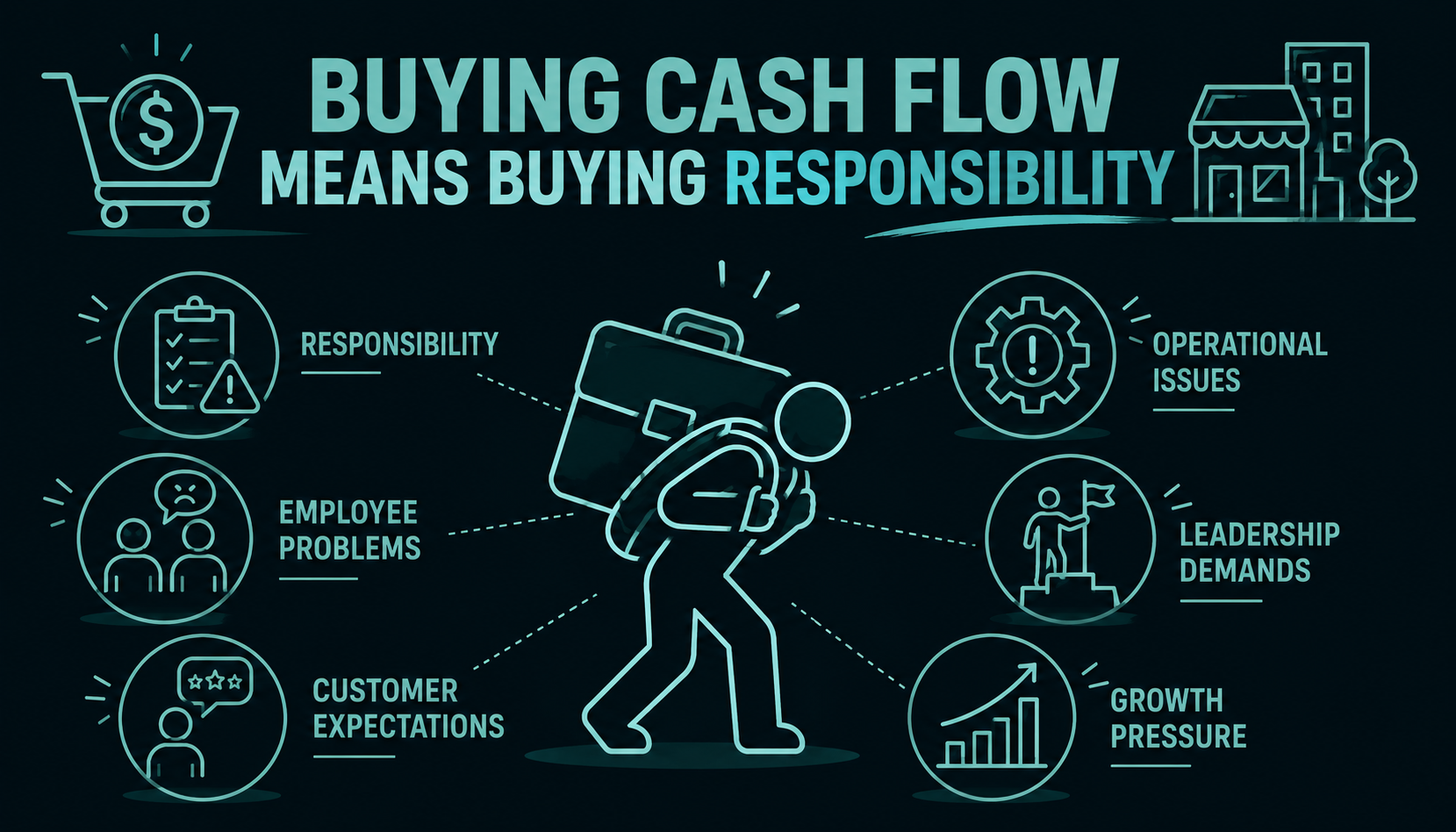
One of the biggest mistakes buyers make is believing they are buying freedom.
That is especially true in smaller businesses, where the owner is often still deeply involved in day to day operations, customer issues, staffing, and decision making. On paper, it may look like you are buying a business that can run on its own, but in reality, you may be buying a role that still needs a very hands on owner.
In reality, you are often buying:
- Responsibility
- Employee problems
- Customer expectations
- Operational issues
- Leadership demands
- Growth pressure
Until a business reaches enough scale and structure, the owner usually remains the engine behind growth.
That is normal. That is small business ownership.
In many cases, the owner is still the one pushing sales, solving problems, checking quality, and keeping everything moving forward. Even if there are employees in place, the business often still depends heavily on the owner’s judgment and involvement.
Key Takeaways Before You Buy
So should you buy a business you cannot operate yourself?
Usually, I would say be very careful. If it is a smaller operation and you cannot understand the work, manage the people, evaluate decisions, or solve problems, the risk increases dramatically. In that kind of business, the owner is often still the main driver behind day to day operations, customer service, quality control, and problem solving. If you do not understand how those pieces fit together, it becomes much harder to step in and lead with confidence.
That said, if the business is larger, has strong systems, experienced managers, and is not overly dependent on one or two key people, it may become a very different opportunity. At that point, you may be buying into a more established structure where leadership matters more than technical hands on knowledge. Even then, you still need enough understanding to ask the right questions, spot problems early, and make smart decisions.
Before buying, ask yourself one simple question: can I realistically understand this business well enough to run it?
If the answer is no, then either look for something bigger with established systems already in place or be prepared to learn faster than you ever have before.
Buying the wrong business can create years of stress and expensive lessons, which is why choosing a business you can realistically operate matters so much. We talked more about this in Buying the Wrong Business Might Be the Worst Decision You Ever Make.
Because when you buy a business, you are not just buying cash flow. You are buying the responsibility to lead.