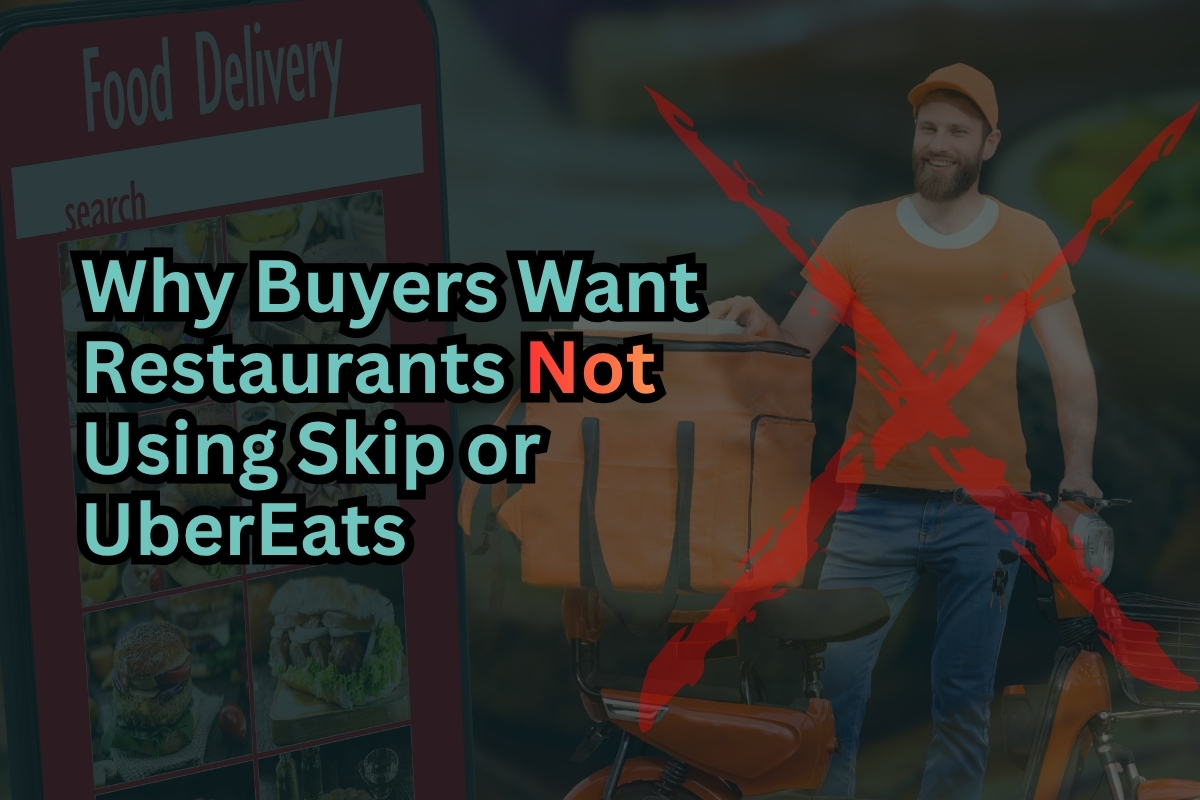
When entrepreneurs and business investors look at restaurant opportunities, one key factor is often overlooked: delivery platform dependency. Many buyers assume that a restaurant already partnered with Skip The Dishes or Uber Eats is a safer investment. In reality, there is increasing interest in restaurants that do not rely on these third-party delivery platforms.
This preference is driven by a combination of financial, operational, and strategic factors. Restaurants that operate independently of delivery apps can retain more revenue, maintain stronger customer relationships, and develop new revenue streams that third-party apps often limit. For buyers seeking a sustainable and profitable investment, these restaurants represent significant opportunity.
How Much Do Delivery Apps Really Cost?
Many restaurant owners know delivery apps charge commissions, but few stop to calculate what those fees amount to over an entire year.
As business brokers, we often hear the same comment from restaurant owners across Vancouver Island:
“The orders keep coming, but the profit doesn’t.”
Delivery apps such as Uber Eats and SkipTheDishes can be excellent customer acquisition tools. They help restaurants reach customers who may never have discovered them otherwise. However, problems arise when businesses become heavily dependent on these platforms instead of treating them as one marketing channel among many.
Consider a simple example.
A restaurant receives 50 delivery orders per week with an average ticket of $25.
- Monthly delivery revenue: $5,000
- Delivery platform commission (30%): $1,500
- Remaining before food, labour, rent and utilities: $3,500
That remaining amount is not profit.
Food costs, packaging, kitchen wages, rent, insurance and utilities still need to be paid. What initially appears to be healthy revenue can produce surprisingly little profit once every expense has been deducted.
Viewed annually, the numbers become even more significant.
$1,500 per month in commissions equals $18,000 every year.
That could pay for new kitchen equipment, several months of rent, another employee, or simply increase the business’s cash flow and value.
This is exactly the type of expense sophisticated buyers examine during due diligence.
Industry Trends and Key Statistics
Understanding the financial impact of delivery platforms is critical for anyone considering a restaurant purchase. Recent industry studies highlight the costs and limitations of third-party delivery services:
- Third-party platforms often charge 15–30% commission per order, significantly cutting into profit margins.
- A survey of Canadian restaurants found that 55% of establishments report only slight profitability from using delivery apps, and 21% report no profit at all.
- Despite these challenges, 60% of consumers order delivery at least once a week, showing strong demand for convenient options but not necessarily through third-party platforms.
- Restaurants that implement direct online ordering systems, through their own website or app, can increase average order value by 20–30% compared to phone or in-person orders.
- Up to 70% of customers prefer ordering directly from a restaurant when given the option, primarily to avoid added fees and support the business directly.
- Restaurants can improve profit margins by 10–20% by shifting even a portion of orders from third-party apps to direct ordering channels.
These statistics demonstrate that while delivery is a growing consumer trend, restaurants that control their own ordering and delivery systems can capture a larger portion of each sale and maintain higher overall profitability.
Benefits of Buying a Restaurant Not Using Third-Party Delivery Platforms
1. Higher Profit Margins
The most immediate and obvious benefit is financial. Third-party apps can take a substantial portion of each order, often leaving the restaurant with minimal profit. By owning a restaurant that does not rely on these services, buyers immediately retain more revenue from every sale. This means healthier profit margins from day one, a critical factor for business growth and long-term sustainability.
2. Direct Access to Customers
When customers order through platforms like Skip or Uber Eats, the platform, not the restaurant, owns the customer data. This lack of control limits marketing and loyalty-building opportunities. Restaurants that manage their own orders can:
- Collect customer information such as emails and phone numbers
- Build loyalty programs to encourage repeat business
- Launch promotions and marketing campaigns directly to customers
Owning these relationships increases lifetime customer value and allows for strategic growth beyond one-time sales.
3. Customer Ownership Is Often More Valuable Than the Commission
Many restaurant owners focus on the 15% to 30% commission charged by delivery platforms, but the hidden cost is often even greater.
When a customer orders directly from your restaurant, you own that relationship. You can collect email addresses, build loyalty programs, promote seasonal specials, encourage repeat visits, and market directly to existing customers.
When customers order through Uber Eats or SkipTheDishes, that relationship largely belongs to the platform instead.
In most cases, restaurants do not receive:
- Customer email addresses
- Phone numbers
- Detailed purchase histories
- The ability to directly market future promotions
This means the platform controls much of the ongoing relationship with your customer.
A customer who has ordered from your restaurant ten times through a delivery app may still think of themselves as a customer of the app rather than your restaurant. The next time they open the platform, your competitors are only one click away.
Restaurants that build direct relationships with customers create more predictable repeat business while reducing dependence on third-party platforms. From a buyer’s perspective, this makes the business more defensible and often more valuable.
4. Greater Control Over Brand and Customer Experience
Third-party delivery can create inconsistencies in the customer experience. Issues such as delayed delivery, mishandled orders, and damaged packaging reflect poorly on the restaurant, even though they are outside of its control. Restaurants that handle their own delivery or focus on dine-in and pickup maintain full control over service quality, timing, and presentation, ensuring that their brand is consistently represented.
5. Enhanced Business Valuation
Investors and future buyers are increasingly interested in stable, predictable revenue streams. Restaurants that are not dependent on third-party delivery demonstrate greater independence and lower operational risk. This stability can translate into a higher valuation when it comes time to sell or attract investors. Buyers view restaurants with more direct sales and fewer external dependencies as strategic, scalable, and more profitable long-term investments.
6. Opportunities for New Revenue Streams
Restaurants that avoid third-party delivery can develop innovative and higher-margin revenue streams, including:
- Direct online ordering through a website or app
- Loyalty and subscription programs that encourage recurring purchases
- Catering and bulk order services handled directly
- Pickup promotions and bundled meal options
These strategies allow restaurants to diversify income beyond dine-in revenue and retain a larger portion of each sale. This approach can transform a restaurant’s profitability and offer buyers a more robust return on investment.
Many owners assume “direct ordering” requires building an expensive mobile app, but today’s technology makes it much easier. Direct ordering can be as simple as:
- Online ordering through the restaurant’s website
- A Google Business Profile ordering link
- QR codes on takeaway packaging
- Instagram or Facebook ordering links
- Loyalty discounts for customers who order direct
The goal is not to eliminate delivery apps completely. Instead, many successful restaurants use a two-channel strategy—delivery platforms to acquire new customers and direct ordering to retain repeat customers. Even moving a portion of regular customers to direct ordering can save thousands of dollars each year while strengthening long-term customer loyalty.
7. Reduced Operational Costs
Beyond commissions, third-party platforms can increase operational complexity. Restaurants must manage order integration, packaging requirements, and platform-specific fees. Independent delivery or in-house systems reduce these operational burdens, simplify workflows, and lower costs, further enhancing profitability.
What This Means for Restaurant Buyers
From a business brokerage perspective, buyers are increasingly looking beyond total sales and focusing on sustainable cash flow. Restaurants with strong direct ordering, repeat customers, and limited dependence on third-party delivery platforms are often viewed as lower-risk investments with stronger long-term growth potential. A business that owns its customer relationships can adapt more easily to changing commission structures, market conditions, and consumer trends.