It’s a bit wild to look back and realize that a decade ago, Facebook Ads were already a cornerstone of digital marketing yet they operated on a completely different set of rules.
Back then, running Facebook Ads in tight geographic zones meant higher click costs, but it forced a relentless focus on message clarity, offer structure, and audience psychology. Many of those early manual campaigns laid the foundation for long-term customer bases.
While the tools were crude and the analytics were primitive, the core fundamentals of conversion still applied. Here is a breakdown of how Facebook advertising has evolved over the last decade, supported by current industry data, and what it means for growing your business today.

Facebook Ads 10 Years Ago: Simple, Manual, and Text-Driven
In the mid-2010s, Facebook ad units were basic:
- A short, rigid headline
- A small block of static text
- A single 1:1 ratio image
There were no Reels, no Stories, and vertical video was virtually non-existent. While you competed in a significantly less crowded newsfeed, standing out required sharp copywriting and distinct positioning.
1. Hyper-Local Targeting and High Initial Costs
Advertising within a narrow radius or small local market meant working with small audience pools. Frequency capped quickly, CPMs (cost per thousand impressions) spiked, and there was zero algorithmic leeway. Every dollar required intentionality.
To make campaigns profitable, success hinged on rigorous A/B testing:
- Testing hooks and headline variations
- Tweaking micro-copy in the body text
- Weighing emotional appeal against straightforward offer details
Because broad-audience optimization didn’t exist, even subtle wording adjustments directly impacted click-through rates (CTR).
2. Fragmented Conversion Tracking
Before advanced tracking protocols, measuring downstream business impact was a challenge. You could place basic conversion pixels on a thank-you page, but analyzing metrics like Lifetime Value (LTV) or multi-touch attribution required manually stitching together platform reporting with web analytics and CRM systems.
Tracking performance came down to tracking core economics:
- Which specific offer drove measurable follow-up revenue?
- What message yielded the lowest true customer acquisition cost?
Today, managing profitability across marketing efforts requires a firm grasp on metrics like your overall
The Evolution: Key Breakthroughs in Meta Advertising
1. From Static Images to Short-Form Video Dominance
The shift toward video content fundamentally reshaped the platform. Meta’s ad revenue has expanded dramatically over the past decade, growing into a global advertising powerhouse that generates over $130 billion annually.
Video fundamentally altered user behavior on the platform:
- Attention capture: Video stops feed-scrolling significantly faster than static images.
- Rapid storytelling: A 15-second vertical video can demonstrate a value proposition, overcome objections, and present a call-to-action (CTA) almost instantaneously.
- Trust building: User-generated content (UGC), informal founder videos, and direct screen recordings routinely outperform overly polished studio productions.
2. On-Platform Lead Generation
The introduction of Native Lead Ads eliminated a major friction point: forcing mobile users off-platform to external landing pages.
By utilizing auto-filled form fields using a user’s Facebook profile data, Native Lead Forms drastically boosted conversion rates—particularly for high-touch industries like professional services, real estate, B2B, and local service providers.
3. Advanced Custom and Lookalike Audiences
Perhaps the single largest technological leap was the rollout of custom audience matching and machine-learning algorithms.
Today, advertisers can easily:
- Retarget high-intent website visitors based on specific site actions.
- Upload customer lists to build high-value Lookalike Audiences (LALs).
- Allow broad targeting algorithms (like Advantage+ Placement and Advantage+ Detailed Targeting) to automatically discover buyers based on creative resonance rather than manual demographic toggles.
Rather than relying purely on manual demographic guesses, modern campaigns utilize dynamic algorithms to find prospective buyers who match your existing customer profile. This machine-driven outreach mirrors modern deal sourcing techniques like
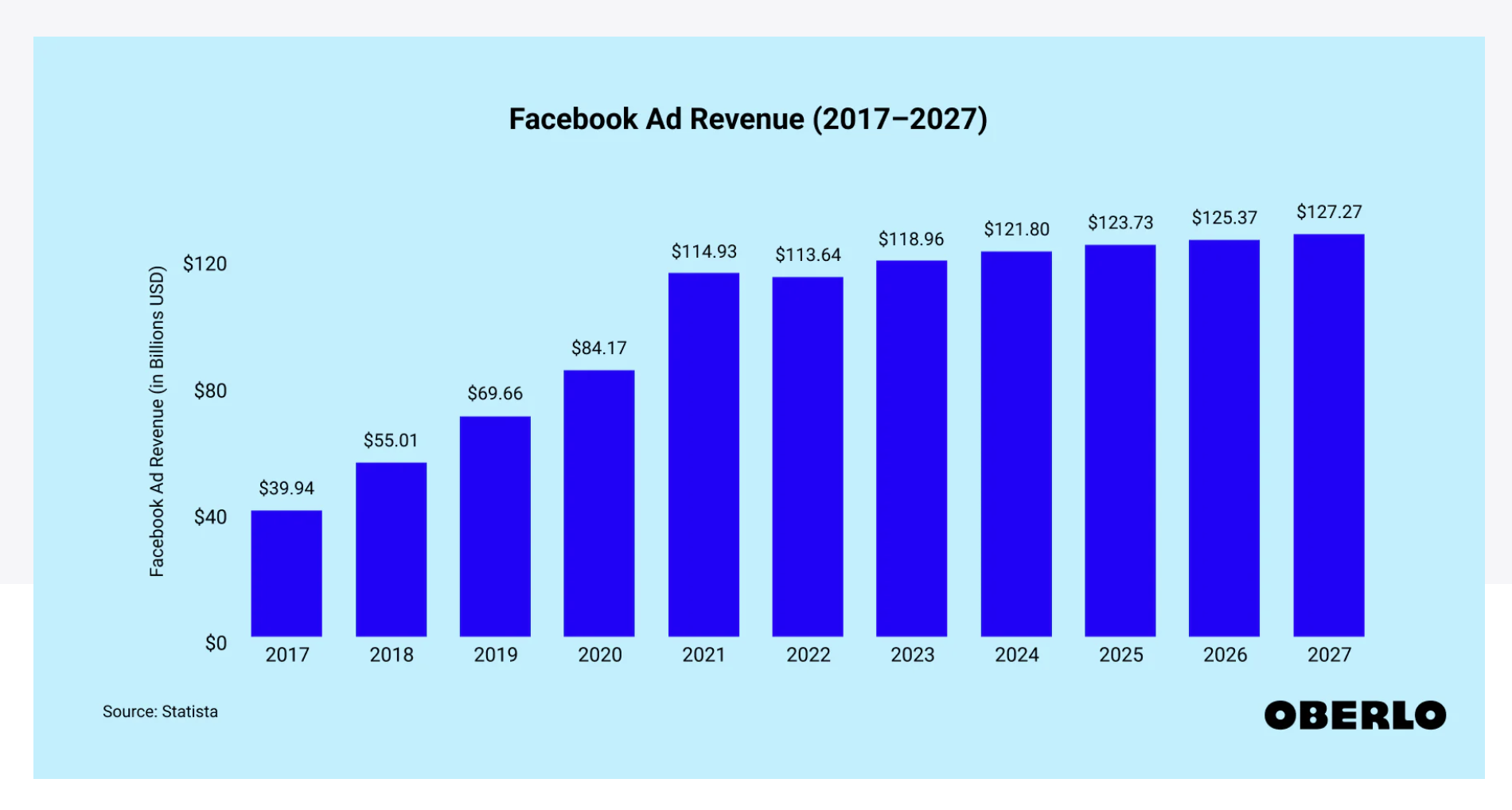
Source: Oberlo
What Hasn’t Changed: Creative Testing is Still King
While automation and AI handle much of the bidding and delivery optimizations today, human strategy and creative iteration remain the primary growth drivers.
| Then (10 Years Ago) | Today |
| Testing short headline variations | Testing 3-second video hooks |
| Tweaking 200-character text blocks | Testing distinct creative formats (UGC vs. Motion Graphic vs. Founder Video) |
| Manual zip-code and interest targeting | Algorithmic targeting powered by creative messaging |
| Simple landing page clicks | Native lead forms, dynamic product ads, and automated messaging flows |

AI Is Also Changing the Ads Themselves
AI isn’t just being used to decide who sees an advertisement. It is increasingly being used to help create the advertisement itself. Meta has introduced generative AI features that can create or significantly edit advertising imagery and other creative elements. These tools can help advertisers adjust backgrounds, resize images for different placements, generate variations of existing creative, and develop alternative versions of an advertisement for testing. Meta has also said it is adding transparency labels when its AI tools are used to create or significantly edit certain ads, giving users more information about how the content was produced.
This creates an interesting future for advertisers. Instead of manually producing five separate advertisements, a marketer might begin with one strong concept and use AI to generate multiple variations. The system could test different backgrounds, image crops, headlines, calls to action, formats and placements. It could also help adapt the same core message for different audiences, such as existing customers, website visitors or people who have never heard of the business before. A single campaign could therefore produce a much wider range of creative options without requiring the same amount of time, design work and production expense.
The real advantage is not simply that AI can create more advertisements. It is that AI can help advertisers learn which combinations are most effective. One version might perform better because the headline is clearer. Another might generate more engagement because the image feels more natural. A short video may work better in Reels, while a different image and message may be more effective in the Facebook feed. Over time, the system can compare these variations and identify patterns in what encourages people to click, submit a form, make a purchase or contact the business.
This does not mean that human judgment is no longer important. AI can generate variations, but it does not automatically understand a company’s reputation, customers, positioning or long-term business objectives. A poorly written message can still be amplified by automation, and a visually attractive advertisement can still promote the wrong offer. Advertisers need to provide the strategy, define the objective, review the creative and make sure the final message is accurate, appropriate and consistent with the brand.
The advertiser is therefore moving from being someone who manually builds every advertisement to someone who directs and evaluates an automated creative system. The work becomes less about producing every individual version and more about developing the right concept, setting clear goals, supplying useful information and judging whether the results are actually improving. In that sense, AI is not replacing the fundamentals of advertising. It is changing how quickly those fundamentals can be tested, refined and applied.
Facebook Is Still Huge
It is easy to assume Facebook has become irrelevant because younger audiences have moved toward other platforms.
But the numbers don’t really support the idea that Facebook has disappeared.
DataReportal’s 2026 Canada report, using Meta’s advertising data from late 2025, estimated Facebook’s Canadian advertising reach at 24.6 million people. Instagram’s reach was approximately 21.0 million.
Globally, Facebook’s potential advertising audience was approximately 2.28 billion people in January 2025, according to Meta advertising data analysed by DataReportal.
Meta’s overall business is enormous as well.
For full year 2025, Meta reported $200.97 billion in revenue, up 22% year over year. Its Family of Apps delivered 12% more ad impressions during the year, while average price per ad increased 9%.
Facebook isn’t disappearing.
It is becoming part of a much larger advertising machine.
Whether you are scaling a local service company or preparing an established enterprise for market, digital distribution and automated systems are key drivers when learning
Conclusion
Facebook Ads have evolved from basic desktop banner units into a sophisticated ecosystem driven by short-form video, machine learning, and native lead generation. The delivery tools are faster, the data infrastructure is more refined, and the potential reach is vastly larger.
Yet the core principle of direct-response marketing remains unchanged: Understand your audience deeply, test messaging relentlessly, and build for long-term customer value.
If your advertising framework hasn’t updated alongside these platform shifts, you are likely overpaying for customer attention. Adapting to modern creative testing and automated funnels ensures your business stays competitive in an increasingly digital acquisition market.