Many business owners assume that if their corporation stops operating or stops making money, tax obligations simply disappear. Unfortunately, that is not how it works in Canada.
Even if your corporation made no income or has become inactive, there are still filing responsibilities that continue until the corporation is formally closed or dissolved.
If corporate taxes are not paid or returns are not filed, the consequences usually build slowly at first and then become more expensive and difficult to fix later.
Here is what actually happens.
First Things First: Filing Taxes and Paying Taxes Are Not the Same Thing
One of the biggest misunderstandings among business owners is believing that filing and paying happen on the same deadline.
For Canadian corporations:
- Corporate income tax returns (T2 returns) generally must be filed within six months after fiscal year end.
- Taxes owing are usually due earlier, often two months after year end, or three months for some qualifying Canadian controlled private corporations.
- Interest can begin accumulating even when the return itself has not reached the filing deadline.
That means a corporation can file on time but still owe interest if payment was late.
Helpful resource: Canada Revenue Agency Corporation Tax Guide
What Happens If Your Corporation Does Not Pay Taxes?
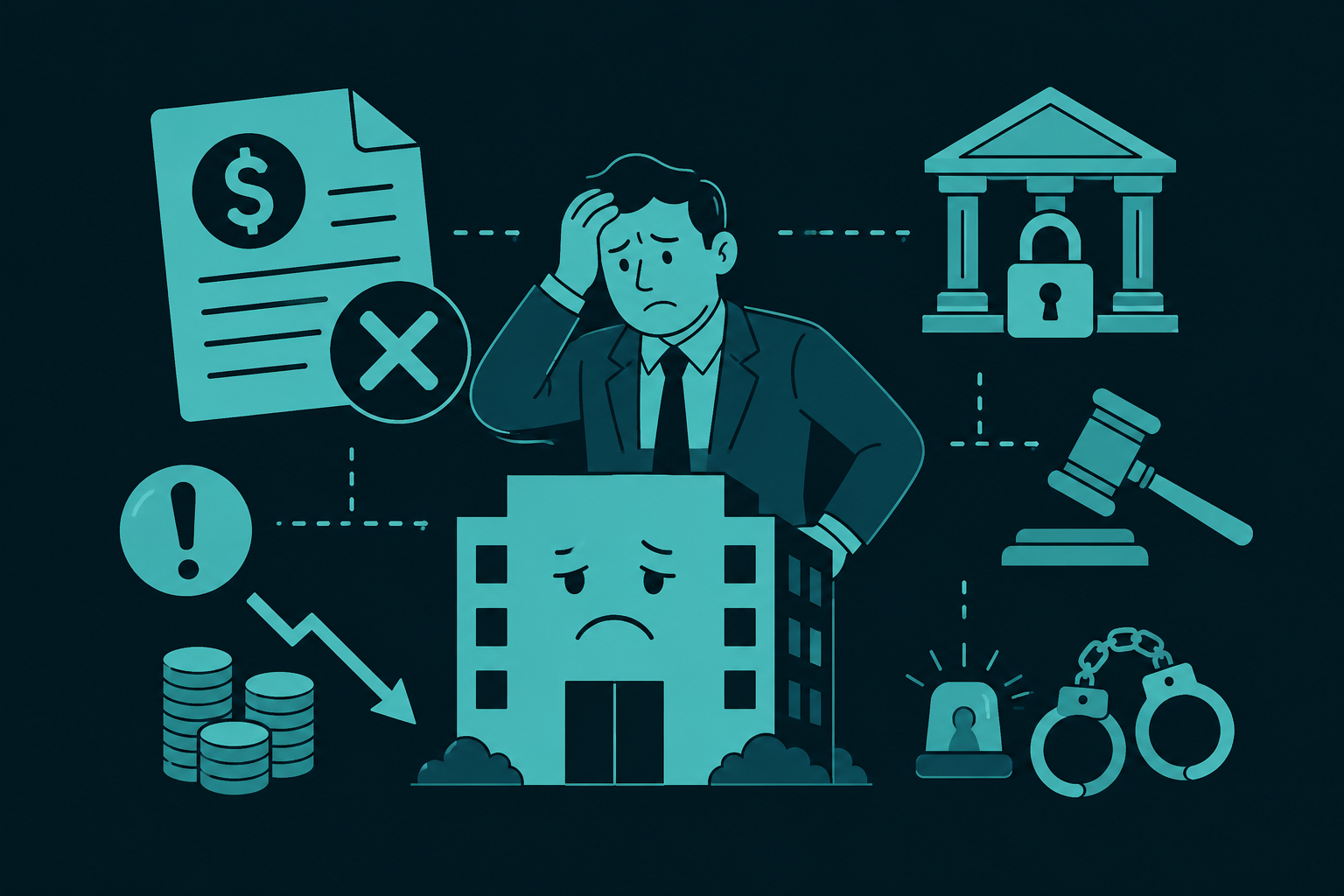
If your corporation owes taxes and does not pay, the debt does not disappear.
The CRA generally starts with collection notices and interest charges. If the balance remains unpaid, collection efforts can become more serious.
Possible consequences include:
- Interest accumulating daily on unpaid balances
- Collection letters and payment requests
- Requirements to provide financial information
- Freezing or redirecting certain payments
- Collection action against corporate assets
- Difficulty obtaining loans or financing
- Problems selling the business later
Because a corporation is normally treated as a separate legal entity, unpaid corporate taxes are usually corporate obligations first. However, there are situations where directors or shareholders may still face exposure depending on guarantees, payroll obligations, distributions, or other circumstances.
Helpful resource: CRA Corporation Information
What Are the Repercussions of Filing Corporate Taxes Late?
Late filing is where many corporations get caught, especially because it often starts as something that feels easy to postpone. A business owner may miss one deadline during a busy season, assume they will deal with it later, and then suddenly realize multiple years have passed. Even corporations that are inactive or earning little to no revenue can still have filing obligations.
The CRA treats late filing seriously because tax returns are part of maintaining compliance, not just paying money owed. Once deadlines are missed, penalties and interest can begin adding up and administrative issues can become more difficult to resolve. The longer a corporation waits, the more expensive and time consuming it can become to get everything back in order.
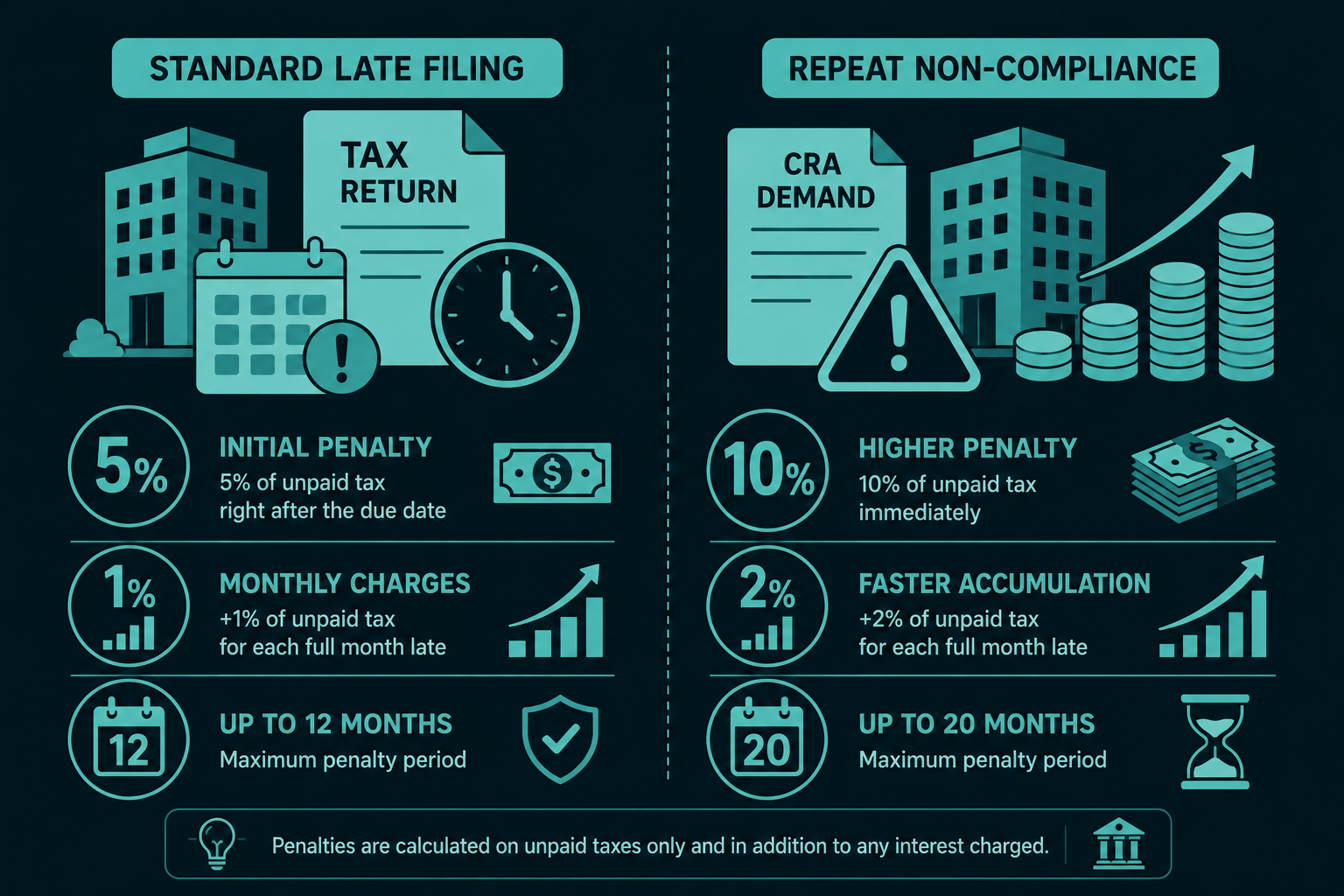
If taxes are owing and the return is filed late, the CRA may apply:
- 5 percent of unpaid tax immediately after the deadline
- Plus 1 percent of unpaid tax for every full month late
- Up to a maximum of 12 months
If the CRA previously demanded a return and the corporation had late filing penalties in recent years, penalties can become significantly larger:
- 10 percent of unpaid tax
- Plus 2 percent per month
- Up to 20 months
Those percentages can become expensive surprisingly quickly.
For example:
A corporation owing $20,000 that files many months late may end up paying thousands more once penalties and interest are added. The initial late filing penalty would apply first, and then interest would continue accumulating on both the unpaid tax and applicable penalties. What may have started as a manageable balance can grow much larger over time, making it harder for the business to catch up financially. This is why filing on time is important even if the corporation cannot immediately pay the full amount owing.
Helpful resource: CRA Avoiding Penalties Information
After How Many Years Does the Corporation Stop Existing?
A common question business owners ask is whether an inactive corporation eventually disappears if enough time passes without filing taxes or operating the business.
The short answer is usually no.
In Canada, a corporation remains a legal entity until it is formally dissolved or otherwise removed through the proper legal process. Simply stopping operations, closing the bank account, or ignoring tax filings does not automatically end the corporation’s existence.
This misunderstanding often happens when owners walk away from a business that is no longer generating revenue and assume there is nothing left to do. In reality, annual obligations may continue depending on the corporation’s status, and unresolved tax matters can remain attached to the company even if it has been inactive for years.
Corporations continue existing until one of the following happens:
- Formal dissolution
- Voluntary closure
- Bankruptcy and legal wind up
- Administrative dissolution for non compliance with corporate registry requirements
Even dissolved corporations can still have unresolved tax obligations or final filing requirements.
This is important because owners sometimes assume inactivity equals closure. In reality, inactive corporations often continue accumulating filing obligations.
Other Disadvantages of Ignoring Corporate Taxes
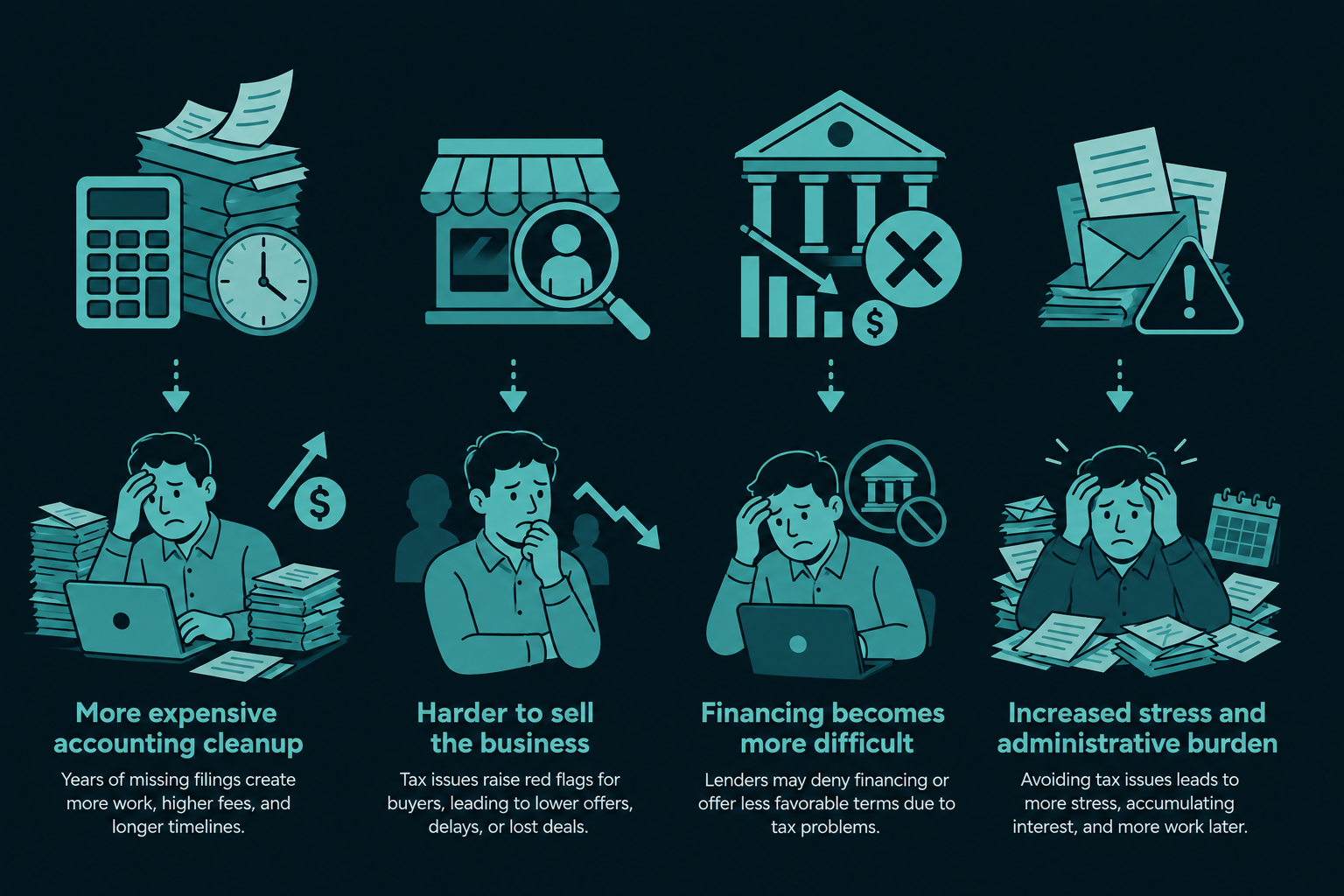
The actual tax bill is often only part of the problem. When corporate taxes are ignored, the financial impact can extend beyond the amount owed and create additional operational and legal challenges for the business over time.
More expensive accounting cleanup
Missing one year of filing can turn into multiple years very quickly, especially when business owners assume they will catch up later and continue postponing it.
As time passes, records often become harder to locate, bank statements may need to be retrieved, and supporting documents can go missing. Accountants then spend additional time reconstructing transactions, reviewing historical activity, and preparing overdue returns accurately.
This extra work usually means higher accounting fees and longer timelines to get the corporation back into good standing. In some cases, missing information can also create delays when responding to CRA requests or completing future business transactions.
Harder to sell the business
Buyers and business brokers often review tax compliance carefully during the due diligence process before moving forward with a transaction.
Outstanding CRA balances, missing corporate tax returns, unresolved penalties, or incomplete financial records can raise concerns and create delays during negotiations. Buyers may view unresolved tax issues as a sign of operational risk or poor record keeping, even if the business itself is performing well.
Tax compliance can also affect valuation discussions since buyers often evaluate financial quality and historical performance when determining value. Read our guide on how to value a business.
In some cases, tax problems can lead to lower offers, requests for holdbacks, additional legal review, or buyers walking away entirely. Keeping corporate taxes current helps maintain business value and makes the sale process smoother and more attractive to potential purchasers.
Financing becomes more difficult
Banks and lenders commonly request financial statements, corporate tax returns, and proof that a business is in good standing before approving financing.
When a corporation has overdue tax filings, unpaid balances, or unresolved CRA issues, lenders may see the business as higher risk. This can lead to delayed approvals, reduced borrowing limits, higher interest rates, or complete rejection of financing applications.
Even if the business is profitable, unresolved tax problems can make it harder to secure operating lines of credit, equipment financing, commercial mortgages, or funding needed for growth and expansion.
Businesses with unresolved tax issues may also find it harder to qualify for financing or prepare lender ready documentation. Learn more in our step by step commercial loan application guide.
Increased stress and administrative burden
Business owners often avoid opening CRA notices because the problem feels overwhelming or stressful, especially when they are unsure how much is owed or how many filings have been missed. It is common for owners to put the issue aside temporarily while focusing on day to day operations, but tax problems rarely stay the same over time.
Unfortunately, delays usually make cleanup harder and more expensive. Interest continues accumulating, records become more difficult to locate, and catching up on multiple years of filings can take considerably more time and effort. Addressing the issue early often gives business owners more flexibility and more manageable solutions.
What If the Corporation Has No Income?
Many owners ask whether filing is necessary if the company earned nothing. This is a common misunderstanding, especially for corporations that have stopped operating or have been sitting inactive for a long period of time.
In Canada, corporations are generally still expected to file annual returns even if there was no business activity and no income earned during the year. Having zero revenue does not automatically remove filing obligations or mean the corporation no longer exists.
While penalties are often more serious when taxes are actually owing, failing to file can still create administrative issues and make it more difficult to catch up later. If your corporation has been inactive for several years, it is usually a good idea to speak with an accountant or tax professional before deciding whether to dissolve the corporation, submit nil returns, or formally wind down operations.
Can You Fix It If You Are Already Behind?
Usually yes.
In many cases, corporations that have fallen behind on taxes or missed filings can still get back into good standing, but the process becomes more complicated the longer the issue is left unresolved. The CRA generally prefers businesses to come forward and address outstanding obligations rather than continue ignoring them.
The earlier you deal with unpaid taxes or overdue returns, the more options you typically have. Acting quickly may reduce additional interest charges, prevent further collection activity, and make it easier to organize records while information is still available. Even if the corporation cannot pay the full amount immediately, filing overdue returns is often an important first step because it stops additional late filing penalties from continuing to grow.
For corporations with larger balances, there may also be opportunities to discuss payment arrangements directly with the CRA depending on the circumstances.
If catching up on taxes is part of preparing for a future sale, understanding how transactions are structured can help avoid surprises later. Our post on share sale versus asset sale for Canadian businesses explains how buyers often evaluate business obligations during acquisitions.
Practical steps include:
- Confirm all missing filing years
- Calculate taxes actually owing
- File outstanding T2 returns
- Review CRA balances and notices
- Explore payment arrangements if necessary
- Discuss dissolution if the corporation is permanently inactive
Waiting rarely improves the outcome.
Wrapping Up
Having a corporation that does not pay taxes in Canada does not mean the business instantly disappears. In most cases, the corporation continues to exist while penalties, interest, and administrative problems continue growing.
The good news is that most situations become easier to solve when addressed early.
If your corporation has fallen behind, getting filings caught up and understanding your options now can save significant time, money, and frustration later.