Learn what happens when someone breaks a non compete in Canada, including injunctions, damages, court action, and enforceability in business sales.
Non compete agreements are one of the most misunderstood parts of business contracts. Many people assume that if someone signs a non compete, it will automatically be enforced. In reality, the situation is much more complicated.
In Canada, and particularly in British Columbia, courts closely examine non compete agreements before enforcing them. The outcome often depends on who signed the agreement, why it was signed, and whether the restrictions are reasonable.
If someone breaks a non compete, it does not automatically mean they owe money or have committed a crime. However, it can lead to lawsuits, court orders, legal expenses, and significant business consequences.
What a Non Compete Actually Means
A non compete clause is a contract promise where one party agrees not to:
- Start or join a competing business for a certain period
- Operate within a defined geographic area
- Solicit or take former customers
- Use confidential business information
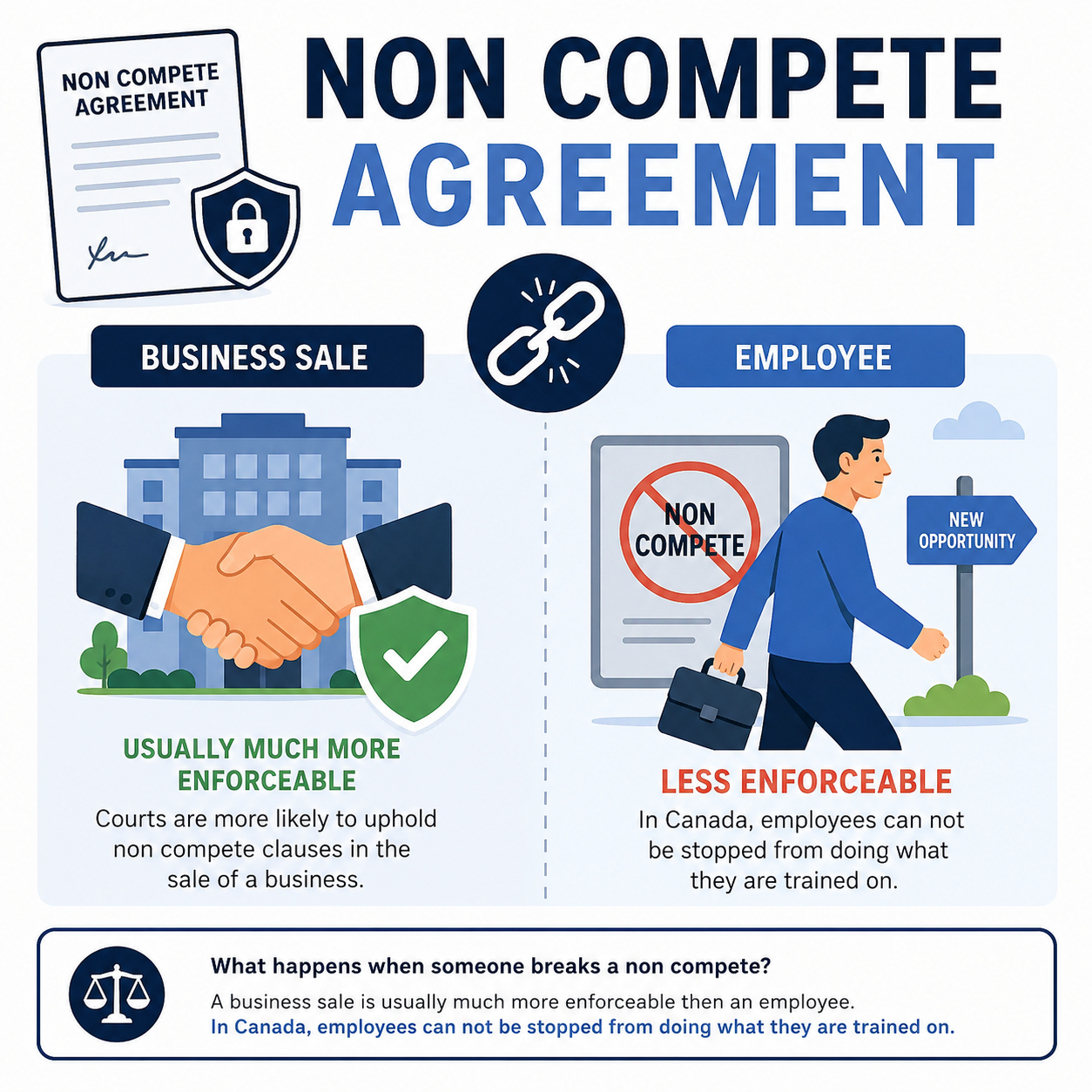
In Canada, courts treat these clauses as restraints on trade, meaning they are not automatically enforceable. The person trying to enforce it must prove it is reasonable and necessary.
You can read more about contract enforcement principles in Canada through the Department of Justice Canada.
Is Breaking a Non Compete a Criminal Offence?
In most cases, no.
A non compete dispute is usually a civil contract matter rather than a criminal issue. The disagreement is typically between two private parties who signed an agreement.
That means the police are generally not involved, and nobody is going to jail for violating a non compete clause.
Instead, the dispute is handled through lawyers, negotiations, and potentially the courts.
What Happens When Someone Breaks It
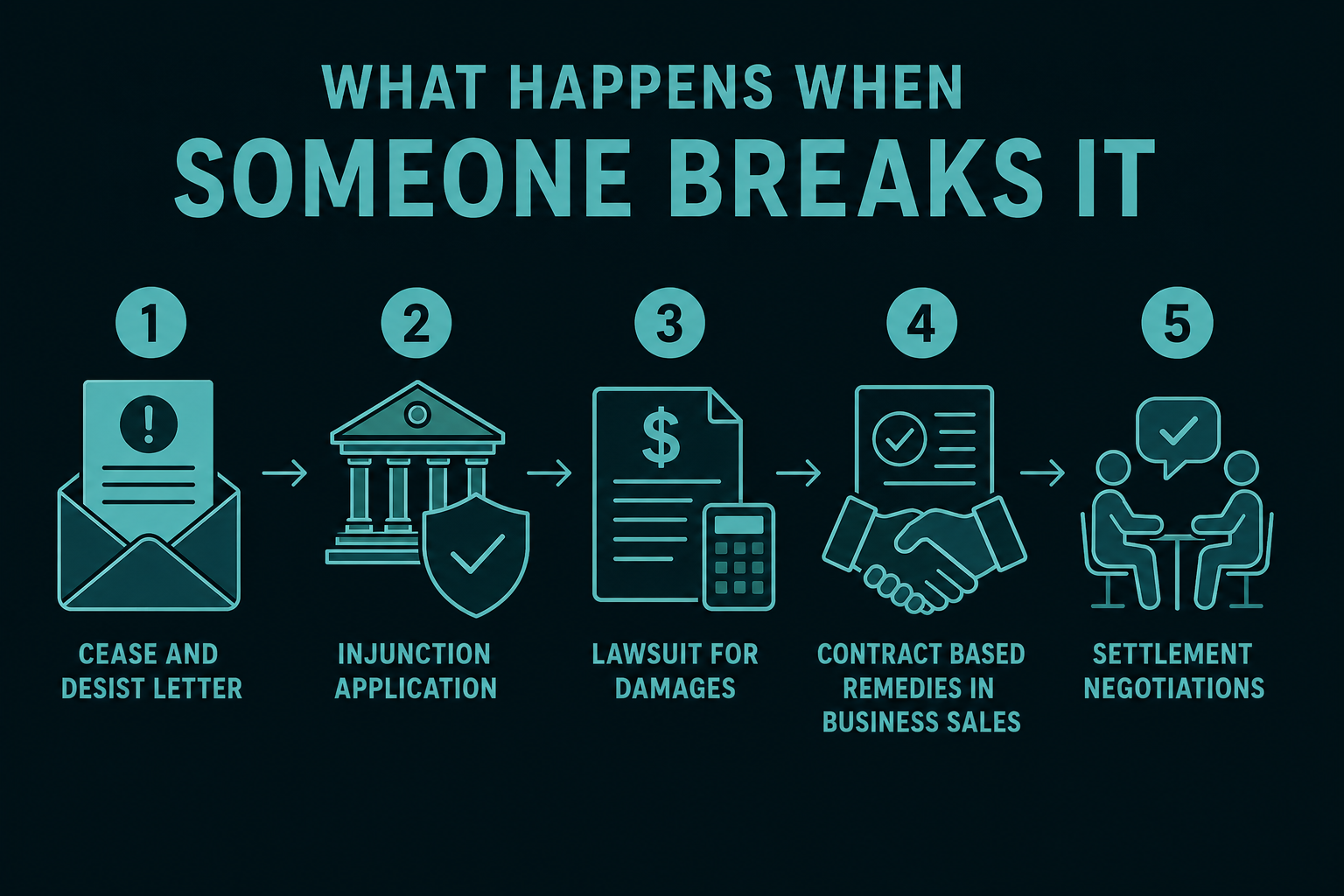
1. Cease and desist letter
This is usually the first move.
A lawyer sends a formal letter demanding that the person stop the competing activity. This can include:
- Stopping business operations in the restricted area
- Stopping customer contact or solicitation
- Returning or deleting confidential information
- Confirming compliance in writing
Often, disputes end here because the letter signals that legal action is likely.
2. Injunction application
This is the most serious and immediate remedy.
An injunction is a court order that can temporarily or permanently stop the person from continuing the competing activity while the case is ongoing.
Courts in British Columbia do grant injunctions if:
- The non compete is clear and reasonable
- There is evidence of actual breach
- The harm to the business is ongoing or difficult to calculate
If granted, an injunction can shut down a competing operation very quickly, even before a full trial happens.
3. Lawsuit for damages
The injured party can also sue for financial losses. This is where things get more detailed.
Possible claims include:
- Lost profits from diverted customers
- Loss of business goodwill
- Revenue decline caused by competition
- Costs of replacing customers or contracts
The court will require evidence, such as financial statements, customer records, and business forecasts.
4. Contract based remedies in business sales
This is where business sales are different from employment cases.
In a business purchase agreement, non compete breaches can trigger additional contractual protections like:
- Holdbacks from the purchase price
- Set offs against amounts still owed
- Vendor take back loan enforcement
- Indemnity claims against the seller
This makes enforcement stronger because money is often still tied to the deal.
5. Settlement negotiations
Most non compete disputes do not go all the way to trial.
Instead, parties often settle by agreeing to:
- Stop competing voluntarily
- Pay compensation
- Limit certain activities or regions
- Return customers or business materials
- Sign a binding undertaking
Settlements are common because litigation is expensive and unpredictable.
What Usually Happens First?
Most non compete disputes do not begin with a lawsuit.
The first step is often a cease and desist letter from the party trying to enforce the agreement.
This letter may demand that the person:
- Stop competing immediately
- Stop contacting customers
- Stop using confidential information
- Stop operating within the restricted geographic area
- Return company records, customer lists, or proprietary information
In many situations, the letter alone is enough to start discussions and potentially resolve the dispute before court proceedings begin.
Can a Court Order Someone to Stop Competing?
Yes.
One of the most powerful tools available is an injunction.
An injunction is a court order requiring someone to stop certain activities while the legal dispute is being resolved.
For example, a court could order a former business owner to stop operating a competing company within a specific region until the case is decided.
Courts in British Columbia have granted injunctions where the non compete was clear, reasonable, and necessary to protect a legitimate business interest. However, courts will not automatically grant an injunction simply because a non compete exists. The party seeking enforcement must convince the court that the restriction deserves protection.
For many people, the threat of an injunction is more significant than a future damages award because it can immediately affect their ability to continue operating a business.
Can They Sue for Money?
Yes.
If the non compete is enforceable and the breach caused financial harm, the other party may sue for damages.
Potential claims could include:
- Lost profits
- Lost customers
- Reduced goodwill
- Loss of business value
- Costs associated with repairing the damage
The amount claimed depends on the circumstances and the ability to prove actual losses.
Simply proving that a non compete was breached is not always enough. The party seeking compensation typically needs evidence that the breach caused measurable financial harm.
Contract Remedies in Business Sales
When a business is sold, purchase agreements often contain additional remedies beyond a standard lawsuit.
Depending on the agreement, the buyer may be able to:
- Hold back funds otherwise payable
- Claim against indemnities
- Set off damages against future payments
- Claim against a vendor take back loan
These protections are usually negotiated early in the deal process, often starting from the LOI stage.
This is one reason why non compete agreements connected to business sales are often taken more seriously than those found in employment contracts.
Most Cases Settle
Despite the attention non compete disputes receive, many never reach trial.
Instead, the parties often negotiate a settlement.
A settlement might involve:
- Agreeing to stop competing
- Paying compensation
- Returning customer information
- Signing a formal undertaking
- Clarifying what activities are allowed going forward
Settlement is often less expensive and faster than litigation, making it an attractive option for both sides.
The Most Important Question: Is the Non Compete Enforceable?

This is where many disputes are won or lost.
Canadian courts generally view non competes as restraints on trade. Because they limit a person’s ability to earn a living, courts examine them carefully. The party seeking enforcement must prove the restriction is reasonable.
Courts commonly look at:
- Duration of the restriction
- Geographic scope
- Scope of activities being restricted
- Whether the clause protects a legitimate business interest
- Whether the restriction goes further than necessary
If a clause is vague, overly broad, or unreasonable, a court may refuse to enforce it.
Why Employee Non Competes Are Often Difficult to Enforce
Many people are surprised to learn that employee non competes frequently fail in court.
In Canada, courts generally recognize that employees should be able to continue working in the profession or trade they have been trained to perform.
For example, preventing an accountant from working as an accountant or a plumber from working as a plumber can be difficult to justify unless very specific circumstances exist.
Courts usually prefer less restrictive options such as:
- Non solicitation agreements
- Confidentiality agreements
- Protection of trade secrets
- Customer relationship protections
As a result, many employment related non competes face a high hurdle before they will be enforced.
Why Business Sale Non Competes Are Much Stronger
The rules change significantly when a business is sold.
A buyer is often paying not only for equipment and assets, but also for goodwill, customer relationships, reputation, and future earning potential. Understanding how goodwill impacts pricing is important, and you can learn more about it when looking at how businesses are valued in Canada.
Because of this, courts are generally more willing to enforce non competes tied to a business sale. The reasoning is straightforward.
The seller should not be able to collect the purchase price and then immediately start a competing business that damages what was sold.
Courts often view business sale non competes more favourably because both parties typically had the opportunity to negotiate terms and receive legal advice. Longer restrictions may also be considered reasonable in this context than they would be in a standard employment agreement.
How Long Does It Take to Get to Court?
This is one of the most common questions.
The answer depends on the type of relief being sought.
An injunction application can often be heard relatively quickly, sometimes within weeks or a few months depending on the urgency of the matter.
A full trial is a different story.
Commercial litigation can take many months or even several years before reaching a final decision. During that time, the parties may continue negotiating, mediating, or pursuing settlement discussions.
Because litigation can be expensive and time consuming, many disputes are resolved before a judge ever issues a final ruling.
Reasons a Non Compete Might Not Be Enforced
There are many reasons a court could refuse to enforce a non compete.
Common examples include:
- The geographic area is too large
- The duration is too long
- The wording is ambiguous
- The activities being restricted are too broad
- A non solicitation clause would have been sufficient
- The restriction does not protect a legitimate business interest
- The agreement attempts to prevent someone from earning a living unnecessarily
Even a well intentioned clause can fail if it is not drafted carefully.
Practical Takeaway
Breaking a non compete does not automatically mean someone owes money or will lose in court.
However, it can trigger serious consequences, including cease and desist letters, injunction applications, damages claims, legal costs, and significant negotiation pressure.
This is why buyers are encouraged to fully understand the acquisition process before relying on restrictive covenants alone.
The key issue is almost always enforceability.
In British Columbia and throughout Canada, courts carefully examine whether the non compete is reasonable in scope, geography, duration, and purpose. Employee non competes are often difficult to enforce, while non competes tied to the sale of a business are generally much stronger because they protect the goodwill that was purchased.
If a reasonable non compete is connected to a business sale, the risks of violating it can be substantial. Before taking action, both buyers and sellers should seek professional legal advice to understand their rights and obligations.