
If you’ve negotiated a great price to sell your business, the last thing you want is to see that number change right before closing. Yet that is exactly what can happen when a purchase agreement includes a working capital adjustment.
Working capital adjustments are extremely common in medium and large business acquisitions, especially when the transaction is structured as a share sale. They are designed to make sure the buyer receives a business that can continue operating normally on day one after closing.
If you are selling your company, understanding how these adjustments work can save you thousands of dollars and help avoid unpleasant surprises during negotiations.
What Is Working Capital?
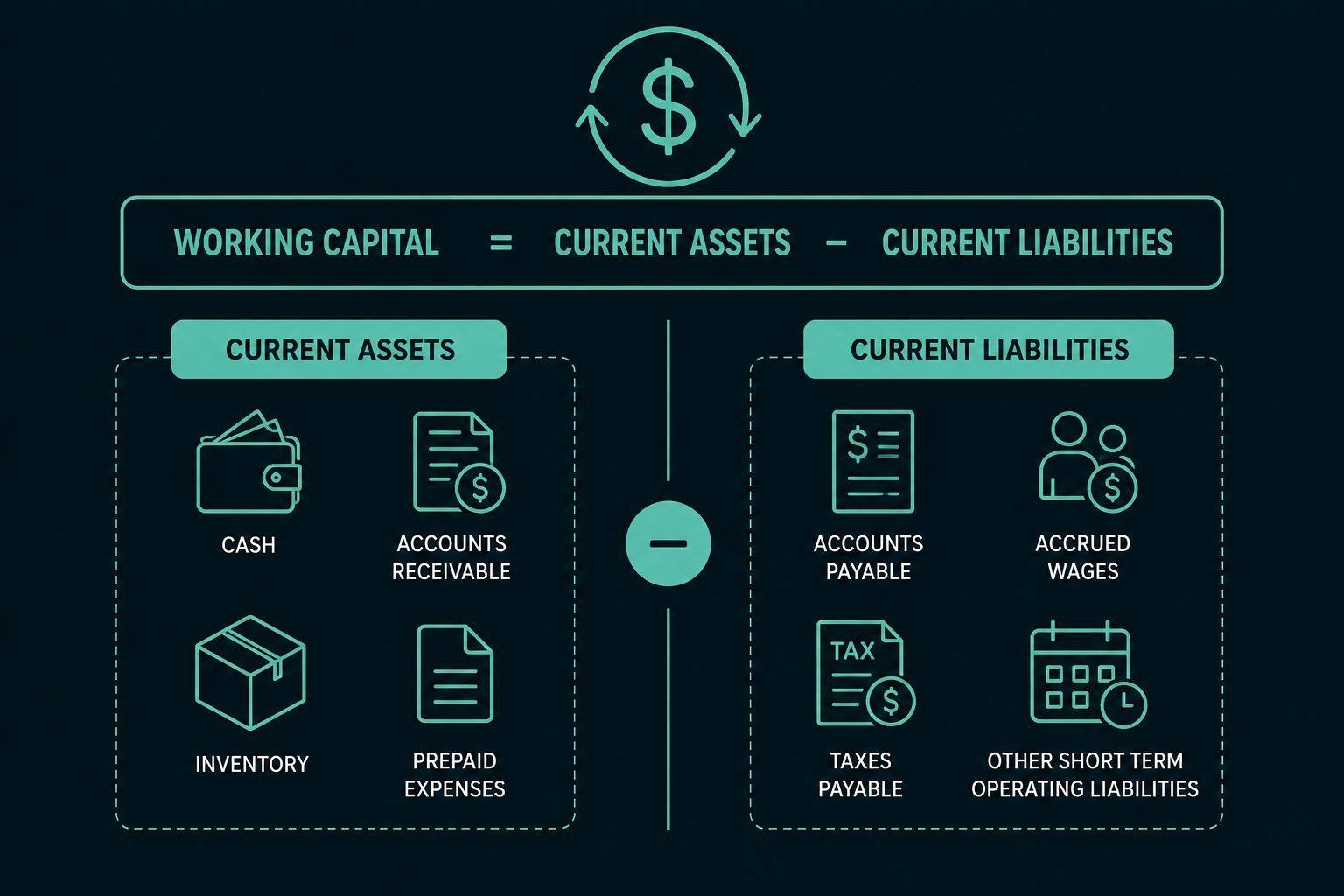
Working capital is simply the money needed to keep a business operating from day to day.
The basic formula is:
Current Assets less Current Liabilities
Current assets usually include:
- Cash used in operations
- Accounts receivable
- Inventory
- Prepaid expenses
Current liabilities generally include:
- Accounts payable
- Accrued wages
- Taxes payable
- Other short term operating liabilities
BDC explains that working capital represents the short term funds required to operate a business and support ongoing growth. As revenue increases, businesses often require additional working capital to finance inventory and accounts receivable.
Why Is Working Capital Important in a Share Sale?
When a buyer purchases shares of a corporation, they are taking over the entire company.
That means they inherit:
- The bank accounts
- Customer receivables
- Inventory
- Supplier obligations
- Existing liabilities
If the seller emptied the bank account, delayed paying suppliers, or dramatically reduced inventory before closing, the buyer would receive a business that may struggle to operate immediately after the transaction.
Working capital adjustments help prevent this situation by ensuring the business transfers with a “normal” level of operating liquidity.
What Is a Working Capital Adjustment?
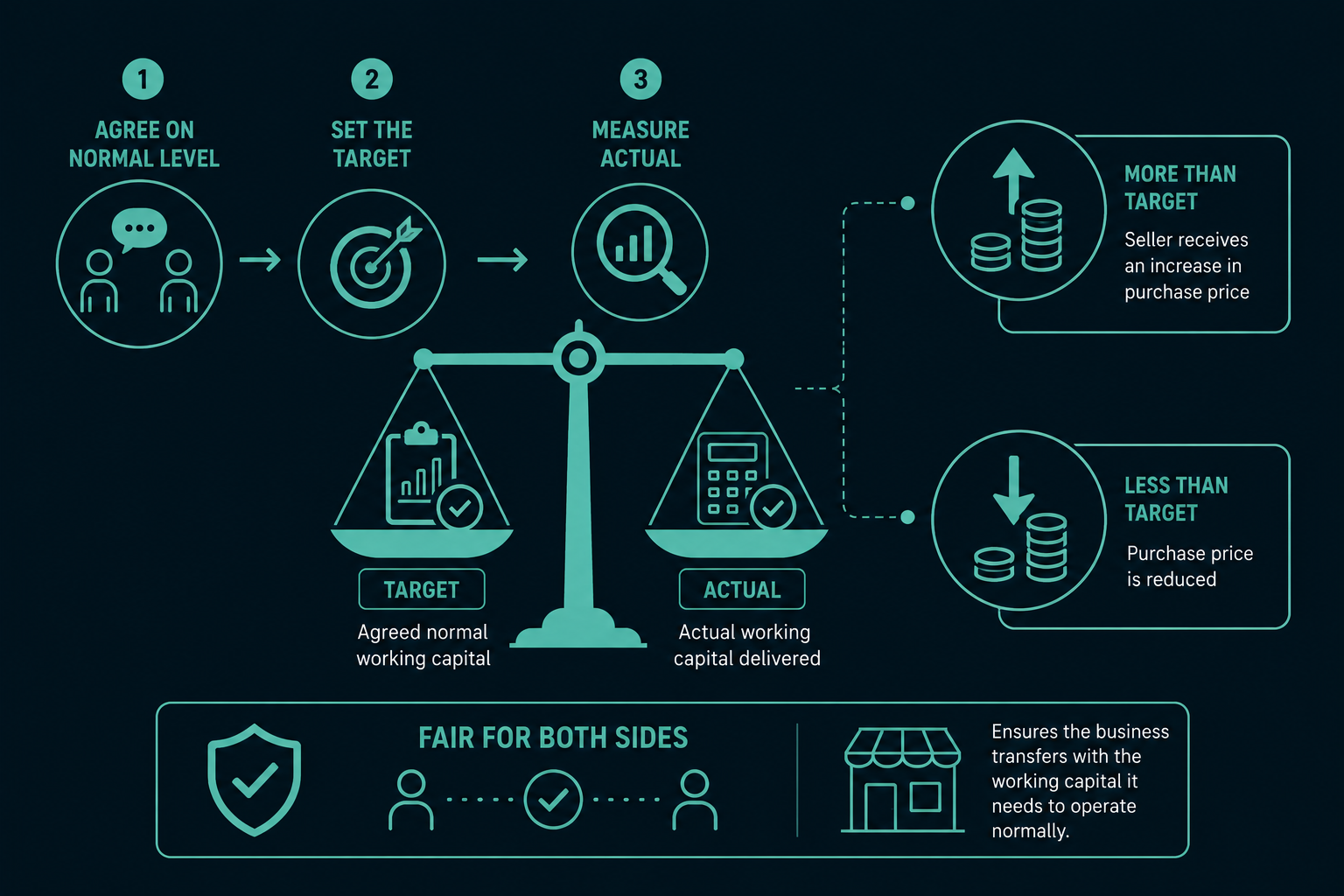
Think of it as a balancing mechanism.
Before closing, both parties agree on what is considered normal working capital for the business.
This amount is often called the working capital target or working capital peg.
After closing, accountants compare the actual working capital delivered to the agreed target.
If the seller delivers more working capital than expected, they may receive an increase in the purchase price.
If they deliver less than expected, the purchase price is typically reduced.
The adjustment is not meant to reward either party. Instead, it ensures that the buyer receives a business capable of operating normally without immediately injecting additional cash.
A Simple Example
Imagine your company sells for $2 million.
Both parties agree that normal working capital should be $300,000.
On closing day, the accountants calculate actual working capital.
Scenario One
Actual working capital equals $320,000.
The business has $20,000 more working capital than expected.
The seller may receive an additional $20,000.
Scenario Two
Actual working capital equals $250,000.
The business is short by $50,000.
The purchase price is typically reduced by $50,000.
Although the headline purchase price remains $2 million, the actual proceeds paid at closing become $1.95 million.
How Is the Working Capital Target Determined?
This is one of the biggest negotiation points during a share sale.
The working capital target is often discussed long before the final purchase agreement is drafted. If you’re preparing an offer, our guide on business LOI checklist explains the key terms buyers and sellers should negotiate early in the process.
Buyers rarely accept whatever number appears on the latest balance sheet.
Instead, they usually review historical financial statements to determine what normal working capital looks like throughout the year.
Factors often considered include:
- Average monthly working capital over the previous twelve months
- Seasonal inventory fluctuations
- Growth trends
- Collection periods for accounts receivable
- Payment cycles for suppliers
For seasonal businesses, a closing date in July may require a very different working capital target than one in January.
The goal is to reflect the normal operating needs of the business rather than a temporary spike or decline.
What Is Usually Included In A Working Capital?
Although every purchase agreement is different, working capital commonly includes:
- Accounts receivable
- Inventory
- Prepaid expenses
- Accounts payable
- Accrued liabilities
- Sales taxes payable
Some items are intentionally excluded.
Examples may include:
- Long term debt
- Shareholder loans
- Income taxes
- Cash not required for operations
- Capital assets
These exclusions should always be clearly defined in the purchase agreement to avoid disputes later.
Why Buyers Want a Working Capital Adjustment
From the buyer’s perspective, they are purchasing an operating business, not just a collection of assets.
Imagine buying a manufacturing company only to discover:
- Inventory has been sold off
- Customers still owe money but collections have slowed
- Suppliers remain unpaid
- Cash reserves have been withdrawn
Even though ownership has changed, the business may immediately require additional financing.
A working capital adjustment reduces this risk by ensuring the company is transferred in its normal operating condition.

Why Sellers Should Care Too
Many business owners assume the agreed purchase price is the amount they will receive.
That is not always true.
Before buyers even negotiate working capital, they typically determine what the business is worth based on its earnings. Our guide on EBITDA vs Adjusted EBITDA (SDE) explains how those earnings are normalized before applying valuation multiples.
Without understanding working capital adjustments, sellers can unintentionally reduce their proceeds by:
- Paying suppliers unusually early
- Collecting receivables aggressively before closing
- Reducing inventory too much
- Changing normal business practices
Preparing for a sale months in advance helps maintain consistent financial statements and reduces the chance of unexpected adjustments.
Share Sales Versus Asset Sales
Working capital adjustments are far more common in share sales than asset sales.
That is because, in a share transaction, the buyer acquires the corporation itself along with its existing assets and liabilities.
Asset sales are often simpler because the buyer can choose which assets they want to purchase while leaving many liabilities behind.
If you are unsure which structure makes the most sense, read our guide on Share Sale Versus Asset Sale, which explains the advantages and disadvantages of each approach and when each structure is typically used.
Some Interesting Canadian M&A Statistics
Canadian mergers and acquisitions remain an active market despite changing economic conditions.
Some interesting figures include:
- Canada recorded thousands of mergers and acquisitions annually across public and private companies, making M&A an important part of business succession and growth strategies.
- Working capital is one of the most common purchase price adjustment mechanisms used in acquisition agreements because it protects both buyers and sellers from unexpected changes between signing and closing.
- BDC notes that growing businesses often require increasing levels of working capital as sales expand, making proper working capital management an important part of business value.
Understanding Working Capital Before You Sell
Working capital adjustments can seem intimidating at first, but they are really about fairness.
The buyer wants confidence that the business will continue operating normally after closing, while the seller wants to be paid fairly for the value they have built.
By understanding how working capital is calculated, agreeing on a reasonable target, and maintaining normal business operations before closing, both parties can avoid costly surprises.
Working capital adjustments are only one way purchase prices can change after negotiations. Another common mechanism is an earn out, where part of the purchase price depends on the future performance of the business after closing.
If you are planning to sell your business, working with experienced business brokers, accountants, and legal advisors can help ensure your purchase agreement reflects a fair working capital adjustment and protects your interests from beginning to end.
Want us to help calculate the working capital for you? Sometimes we pro-rate inventory, so you are not paying full price. We also look at the portion of jobs. Contact us to help sell or buy, where we do this in due dilligence.